

Junior golf rewards are the discounts, entry credits, gear credits, and development perks bundled into a youth membership so a young player can compete and improve without the price tag of full-priced golf. The recommended next step is simple: compare programs on cost, on the strength of their development benefits, and on whether they connect to ranking systems like the World Amateur Golf Ranking (WAGR).
A few names anchor this decision, and you'll see them again below:
- WAGR — the ranking system that gives serious junior competitors visibility to college coaches
- USGA handicap services — the official way to track a verified index
- World Amateur Golf Tour — a membership built specifically for juniors chasing WAGR points
Key Takeaways
The most effective junior golf rewards programs combine steep cost reduction with a genuine competitive or development pathway, not one or the other.
| Point | Details |
|---|---|
| Define the program first | Junior golf rewards mix discounted play, entry credits, and development perks like coaching or scholarships. |
| Match cost to goals | Access-focused cards win on price per round; tournament memberships win on recruiting value. |
| Budget real time | Competitive memberships require weekend tournament travel and multiple weekly practice sessions. |
| Verify before you pay | Check blackout dates, refund policy, and nonprofit transparency through sources like Charity Navigator. |
| Choose by ambition | Worldamateurgolftour fits competitive juniors chasing WAGR points, ranking visibility, and recruiting exposure. |
Table of Contents
- What Are Junior Golf Rewards Programs, Really?
- What Features and Benefits Should You Look For?
- Who Runs These Programs, and What Do They Cost?
- How Do You Choose the Right Program for Your Junior Golfer?
- How Do Rewards Actually Get Redeemed?
- How Do Rewards Connect to Real Development and Recruiting?
- How World Amateur Golf Tour Memberships Support Competitive Juniors
- Five Steps to Join and Get the Most Value
- How Much Time Does a Junior Golf Rewards Program Actually Require?
- Which Junior Golf Rewards Program Gives You the Best Value?
- What Does Parental Involvement Look Like in These Programs?
- Ready to Compete for WAGR Points?
- Sources
What Are Junior Golf Rewards Programs, Really?
Most programs fall into four buckets: flat membership discounts on green fees, points-style loyalty credits, tournament-entry support, and bundled development access like clinics or mentorship. None of these are mutually exclusive. The strongest programs stack two or three of them into a single membership.
The goal behind all of them is the same: keep golf affordable enough that a junior plays often, while giving that player a real path toward getting better and getting seen.
- Discount-only programs solve access but rarely touch development
- Rewards-and-credits programs solve access and add small development perks
- Membership tours built around competition solve development directly through structured events
Pro Tip: Read the membership description closely. Words like "scholarships," "internships," or "WAGR-counting events" signal a program built for development, not just cheaper tee times.
What Features and Benefits Should You Look For?
Every junior golf rewards program earns its membership fee through a specific mix of perks. Some save you cash on the course. Others build a competitive résumé.
- Discounted green fees — often the single biggest recurring savings for families who play weekly
- Tournament entry credits — reduce or offset the entry fee for sanctioned events
- Gear or pro-shop credits — apply toward clubs, balls, or apparel
- Free or discounted lessons — clinics, group instruction, or one-on-one coaching sessions
- Official handicap membership — needed for most tournament eligibility
- Leadership or internship opportunities — resume-building extras tied to nonprofit-run programs
One membership model, Youth on Course, gives juniors access to rounds at $5 or less at thousands of participating courses, while also bundling in scholarship and internship programs. That single structure shows how a low green-fee number and a career-building perk can live inside the same $2 to $5 range that most access-focused memberships fall into.
Who Runs These Programs, and What Do They Cost?
Three provider types dominate this space, and each prioritizes something different. Nonprofit access programs, like the Youth on Course model, focus on driving down the price of a single round. Commercial club programs prioritize loyalty and repeat visits to their own courses. Tournament tours prioritize competitive structure and ranking exposure.
Eligibility usually runs from roughly age 6 through 18 or 19, though some programs extend into early college years. Watch for geographic restrictions. A nonprofit access card is often only valid at partner courses in specific regions, while a national tournament membership works anywhere its events are held.
- Annual membership fees typically vary from free to a modest amount
- Per-round junior rates commonly fall within an affordable range depending on the course
- Tournament memberships add separate per-event entry fees on top of the annual cost
- Blackout dates and cart-fee add-ons are common at commercial club programs
JC Golf's Junior Players Card, for example, charges a $45 annual fee for ages 6 to 19 in exchange for reduced green fees and camp access, a useful benchmark for what a course-group loyalty model costs versus a nonprofit access card.
How Do You Choose the Right Program for Your Junior Golfer?
Pick a program the way you'd pick a coach: on fit, not just on price. Run through this sequence before you commit a dollar.
- Rank your priorities. Decide whether frequent, cheap play or structured development matters more this season.
- Match cost to play frequency. A $50 annual fee only pays off if your junior plays enough rounds to offset it.
- Check the development pathway. Does the membership connect to coaching, WAGR events, or recruiting tools?
- Confirm the time and travel commitment. Local access cards demand less driving than a national tournament tour.
- Read the redemption fine print. Confirm exactly how credits, discounts, and entry coupons get applied.
Before signing up, call or check the website and ask directly:
- Are there blackout dates that limit when discounts apply?
- Are cart fees included, or are they billed separately?
- Does tournament membership guarantee entry, or is it a waitlist?
- What is the refund policy if my junior can't finish the season?
Red flags are usually easy to spot once you know what to look for: vague membership language with no specific redemption process, no published refund policy, or a program that requires heavy travel with zero local support network. Walk away from any program that can't answer the blackout-date question clearly.
How Do Rewards Actually Get Redeemed?
Redemption mechanics vary by program type, but most fall into a handful of predictable paths. Green-fee discounts get applied at the pro shop counter or through an online booking code. Tournament credits get applied directly during event registration. Gear credits work like store credit at a participating pro shop.
The details matter more than they seem. Confirm whether a discounted rate includes a cart or requires walking, and whether blackout days cluster around weekends when your junior actually wants to play.
| Program Type | Typical Redemption Method | Common Limits |
|---|---|---|
| Nonprofit access membership | Discount code or card shown at check-in | Partner courses only, some blackout dates |
| Commercial club loyalty program | Applied automatically at member rate | Cart fees often separate, home-course focused |
| Tournament membership | Entry credit applied at registration | Tied to specific sanctioned events |
How Do Rewards Connect to Real Development and Recruiting?
Cheaper golf only matters if it turns into more reps. A junior who plays twice a month instead of twice a year develops faster, plain and simple, and that increased access is exactly what affordable memberships are designed to unlock.
The bigger payoff shows up in the competitive pathway. Events that count toward WAGR give a junior's results real weight outside their home course, and an official USGA handicap gives coaches a verified, standardized number instead of a self-reported guess.
Programs that pair low-cost access with a genuine competitive structure tend to keep juniors engaged longer than discount-only cards, because the player has something to work toward beyond a cheaper Saturday round.
The USGA rules hub backs nearly every sanctioned junior event with a consistent rule set, which is part of why WAGR-counting tournaments carry weight with college coaches evaluating a recruit's résumé.
- Practice access builds fundamentals
- Sanctioned tournament reps build tournament composure
- Verified handicaps and WAGR points build a résumé coaches trust
Our player development plan guide breaks down how these pieces fit into a multi-year plan.
How World Amateur Golf Tour Memberships Support Competitive Juniors
For a family whose junior golfer is chasing ranking points, not just cheaper tee times, a World Amateur Golf Tour membership is built around exactly that goal. Every sanctioned event counts toward WAGR, which means a junior's scores start building real, portable proof of ability the moment they tee it up.
The membership bundles several pieces competitive families actually need:
- WAGR-counting tournaments at respected, championship-caliber venues
- Tournament registration and live scoring built into one player account
- Rewards redeemable for gear or entry credits, reducing the cost of future events
- Player profiles built for recruiting, giving college coaches a clean record to review
- Ranking tracking so families can see progress event to event
This structure fits competitive juniors best, not casual weekend players. A family aiming for amateur tournament play and eventual college recruiting gets more value here than from a discount-only card, because every round played inside the tour builds toward something measurable. Families still deciding between access-focused and competition-focused programs can review the player development pathway guide for a side-by-side look at how the two models diverge.
Five Steps to Join and Get the Most Value
- Search local coverage. Confirm the program has participating courses or events near you.
- Confirm eligibility and blackout dates. Age brackets and calendar restrictions vary widely.
- Enroll and register a handicap if the program requires one for tournament play.
- Schedule practice and clinic time right after enrollment, before momentum fades.
- Track redemptions. Log every credit used so you know the membership is paying for itself.
Pro Tip: Enroll before peak season or before your area's biggest local events. Early sign-up usually means first access to entry credits before tournament fields fill.
How Much Time Does a Junior Golf Rewards Program Actually Require?

Cost gets most of the attention, but time is the bigger commitment most families underestimate. A membership focused purely on discounted rounds asks for very little: show up, play, save money. A development-focused membership asks for a lot more structure.
Expect practice time to scale with ambition. A junior playing casually might log one or two rounds a month. A junior chasing WAGR points typically needs multiple practice sessions weekly plus consistent tournament rounds, since ranking systems reward consistency over a single strong week.
Tournament weekends add their own layer. A single WAGR-counting event can run two or three days depending on the format, and that's before travel time to the host venue. Families should plan for full weekends during active competition stretches, not just a few hours on a Saturday morning.
Clinics and coaching sessions add smaller, more predictable blocks, usually an hour or two per week. The real planning challenge is balancing school, other sports, and a competitive golf calendar without burning a young player out. Programs that publish a clear event calendar in advance make this dramatically easier to manage than ones that announce tournaments a few weeks out.
The honest takeaway: casual access memberships fit into almost any family schedule, while competitive tournament memberships require the kind of weekend and after-school commitment you'd expect from any serious youth sport. Know which one you're signing up for before the season starts.
Which Junior Golf Rewards Program Gives You the Best Value?
Value depends entirely on what your junior needs, and the math looks different for a casual player than for a competitive one. A program that's a great deal for one family can be a poor fit for another with the exact same budget.
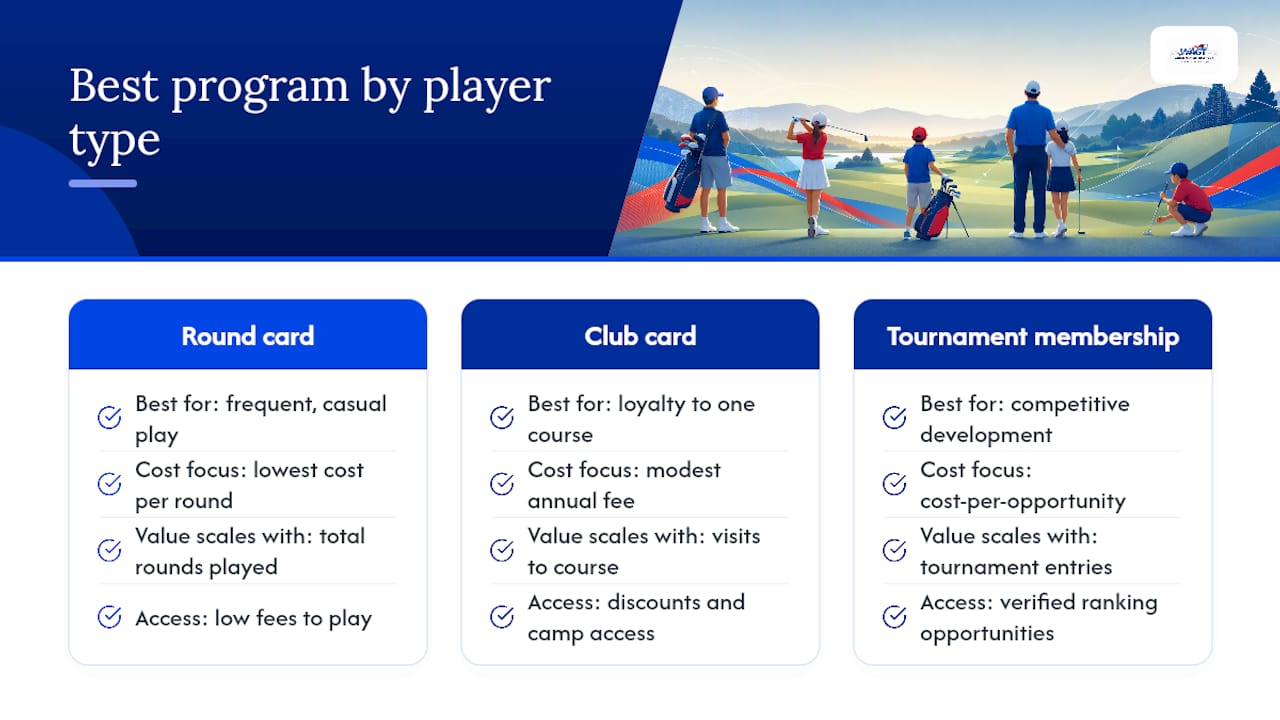
For pure access, a low-cost round card wins on price per round. Paying low fees to play, as Youth on Course structures its membership, delivers one of the lowest costs per round of any model on the market, and that number is hard to beat if frequent, casual play is the only goal.
For loyalty at a single home course, a commercial program like a club's junior card trades a modest annual fee, similar to the examples like JC Golf's structure, for consistent discounts and camp access at courses your family already visits. The value here scales with how often you play that specific course.
For competitive development, the math shifts entirely. A tournament membership isn't priced against cost-per-round, it's priced against cost-per-opportunity. A WAGR-counting event that builds a recruiting résumé delivers value a discount card structurally cannot, because no amount of cheap practice rounds replaces a verified ranking history.
The clearest way to compare: add up how many rounds your junior plays casually versus how many tournaments they'd realistically enter, then weigh each program's cost against that specific mix. A family splitting time between casual play and serious competition often benefits from stacking two memberships rather than forcing one program to do both jobs.
What Does Parental Involvement Look Like in These Programs?
Junior golf rewards programs work best when a parent stays actively involved, not because juniors can't handle logistics, but because most programs put registration, payment, and scheduling responsibility on the account holder, not the player.
Expect your role to include handling enrollment paperwork, confirming eligibility documents like proof of age, and managing the membership account where credits and rewards get tracked. Competitive tournament memberships add another layer: registering for specific events, tracking entry deadlines, and often driving to venues that aren't local.
Communication expectations vary by provider. Nonprofit access programs tend to be low-touch, mostly email updates about new participating courses or seasonal promotions. Competitive tournament memberships run higher-touch, with tournament announcements, scoring updates, and ranking notifications that a parent needs to monitor to keep a junior's development plan on track.
The families who get the most value tend to treat the membership account like a shared calendar, checking it regularly rather than only at renewal time. A junior can play the round, but confirming blackout dates, redeeming credits correctly, and registering for the right tournament bracket almost always falls to a parent, at least until the player is old enough to manage it independently. Programs that offer age-appropriate competition guidance make this easier by clarifying which events actually fit your junior's current level.
A Publisher's Take on What Actually Works
The programs that hold a junior's interest long term aren't the cheapest ones. They're the ones combining low-cost play with a real development pathway, WAGR events, coaching, clear redemption rules, and honest expectations about the weekend commitment competitive golf demands.
Ready to Compete for WAGR Points?
If your junior is playing for more than a cheaper Saturday round, a discount card alone won't get them there. Worldamateurgolftour gives competitive families something the access-focused programs can't: every sanctioned event feeds directly into WAGR rankings, turning tournament weekends into a portable, coach-visible résumé instead of just another scorecard in a drawer.

Membership bundles registration, live scoring, and rewards redeemable for gear or entry credits into one account, so the credits your junior earns actually reduce the cost of the next event they enter. That's a meaningfully different value proposition than a per-round discount card, especially for a family already committed to the tournament schedule.
Visit the World Amateur Golf Tour membership page to review current events, check eligibility, and sign up before the next sanctioned tournament fills its field.