

For this article, "mid-amateur" means the WAGR pathway built for elite junior and collegiate players: the events, points, and grading system that carry a player from junior golf into college recruiting. If you want exposure to college coaches, the move is simple to state and harder to execute: play WAGR-sanctioned events with strong fields, and confirm every event actually meets the setup rules before you enter. Membership programs can support exactly that pathway.
TL;DR:
- Playing only high-grade events with strong fields maximizes WAGR points more than sheer event volume, due to the grading system's focus on field strength.
- Confirm that every tournament division plays from championship-length tees and has at least 16 players for male/mixed events to ensure it counts toward WAGR.
- Incorporate a mix of marquee and lower-grade events, spread across the full 104-week window, to build a consistent and credible ranking profile.
- Membership programs simplify scheduling and verification by providing access to sanctioned events with proper tee and field-size requirements, along with real-time results and recruiting tools.
- Prioritize quality over quantity in tournament selection, since weak results from local, low-grade events can diminish your overall WAGR average.
Table of Contents
- What Mid-Amateur Golf Explained Actually Means for Junior Players
- How WAGR Points Actually Work for Juniors
- Confirming an Event Actually Counts Toward WAGR
- How to Build a Schedule That Actually Moves Your WAGR
- How World Amateur Golf Tour Membership Supports Your WAGR Goals
- Getting Started: Your Pre-Entry Checklist
- Rankings Are a Tool, Not the Whole Plan
- Join World Amateur Golf Tour and Start Earning WAGR Points
- Where to Verify WAGR Rules and Event Eligibility
- Sources
- FAQ
What Mid-Amateur Golf Explained Actually Means for Junior Players
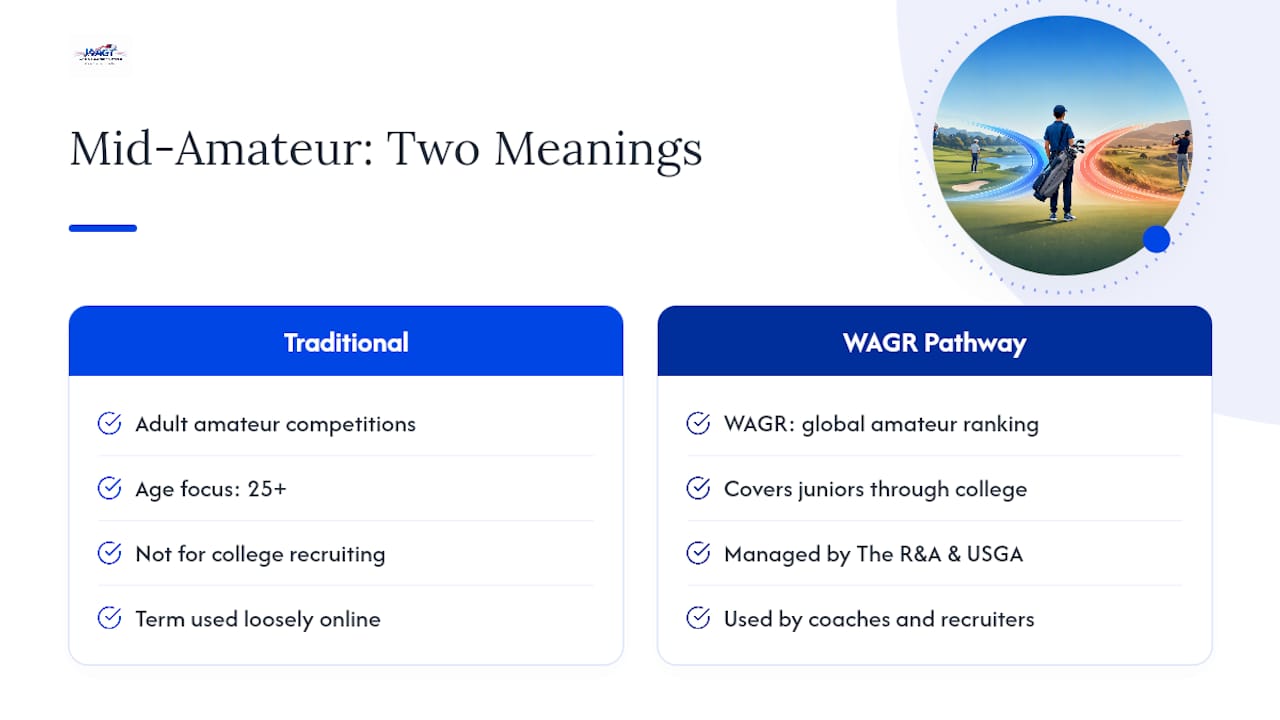
The term gets thrown around loosely, and that causes real confusion for families new to competitive golf. In the traditional sense used elsewhere online, "mid-amateur" refers to adult amateur competitions, typically for golfers 25 and older. That is not the pathway this article covers.
For a junior or college-bound player, what matters is the World Amateur Golf Ranking, managed by The R&A with the USGA as a partner. WAGR ranks amateurs globally across age groups, and it follows a player from age-group junior events straight through college golf. Coaches check it. Recruiting coordinators reference it. It is the one ranking system that spans your entire amateur career instead of resetting every season.
That is the real definition worth carrying forward: mid-amateur golf, in the WAGR/junior-collegiate sense, is about building a rankings profile through sanctioned competition that a college coach can actually verify. Everything else, from tournament selection to entry paperwork, exists to serve that one goal.
How WAGR Points Actually Work for Juniors
WAGR does not simply add up every trophy in your bag. It runs on a rolling 104-week window, and it averages your points using a divisor tied to how many counting events you played. Play well consistently over two years, and your average climbs. Pad your schedule with mediocre results at weak events, and you drag your own average down.
That divisor system is the single most misunderstood part of the ranking for parents new to the pathway. Adding a tenth event to prove you are "serious" can actually hurt a player whose first nine results were strong, because a poor twentieth-place finish at a thin field lowers the average rather than boosting total volume.
Tournament grade drives the math even more than volume does. WAGR assigns every counting event a grade from 1 to 7, and that grade scales the points on offer substantially. A Grade 1 event can hand out several times the points of a Grade 6 event for a similar finish.
- Grade 1–2 events: national and international caliber fields, the highest point ceilings
- Grade 3–4 events: strong regional or multi-state fields, solid points-per-event
- Grade 5–7 events: smaller or more local fields, useful for reps but limited ranking upside
The math rewards discipline. According to WAGR's own FAQ, the rolling window and divisor structure exist specifically so that consistent performance across two years outweighs simply accumulating entries.
Confirming an Event Actually Counts Toward WAGR
An event can look elite on a tournament flyer and still fail to award a single WAGR point. The gap between "impressive-sounding" and "actually sanctioned" trips up more junior families than any other part of this process.
- Check the tee assignment. WAGR only counts divisions playing from championship-length tees. A junior boys' or girls' division set up on shortened tees for pace-of-play reasons may be entirely outside the ranking system, even if the adult division at the same event counts.
- Verify the field-size minimum. Following criteria updates effective in 2025, male and mixed events now need a minimum field of 16 players to count, up from 8. Women's events retained the 8-player minimum. A junior invitational with 12 boys entered simply will not qualify under the new threshold.
- Confirm sanctioning directly with the organizer or the WAGR event listing. Tournament websites do not always update quickly after criteria changes, so a phone call or email beats trusting a two-year-old flyer.
A well-run 54-hole junior event at a respected course can quietly miss WAGR eligibility over a tee-box decision made for pace of play. That is not a hypothetical. It happens every season somewhere in junior golf, and it is the exact reason confirming tee assignments before entry belongs on every family's pre-entry checklist.
How to Build a Schedule That Actually Moves Your WAGR
Building a schedule around your ranking is a planning exercise, not a scramble to enter every event within driving distance. Four steps get most juniors and their families to a smarter calendar.
Step 1: Inventory where you actually stand. Look at your current WAGR position (or lack of one), your academic calendar, and how much travel your family can realistically support in a given semester. A player with zero counting events needs a different plan than one sitting just outside a target ranking band.
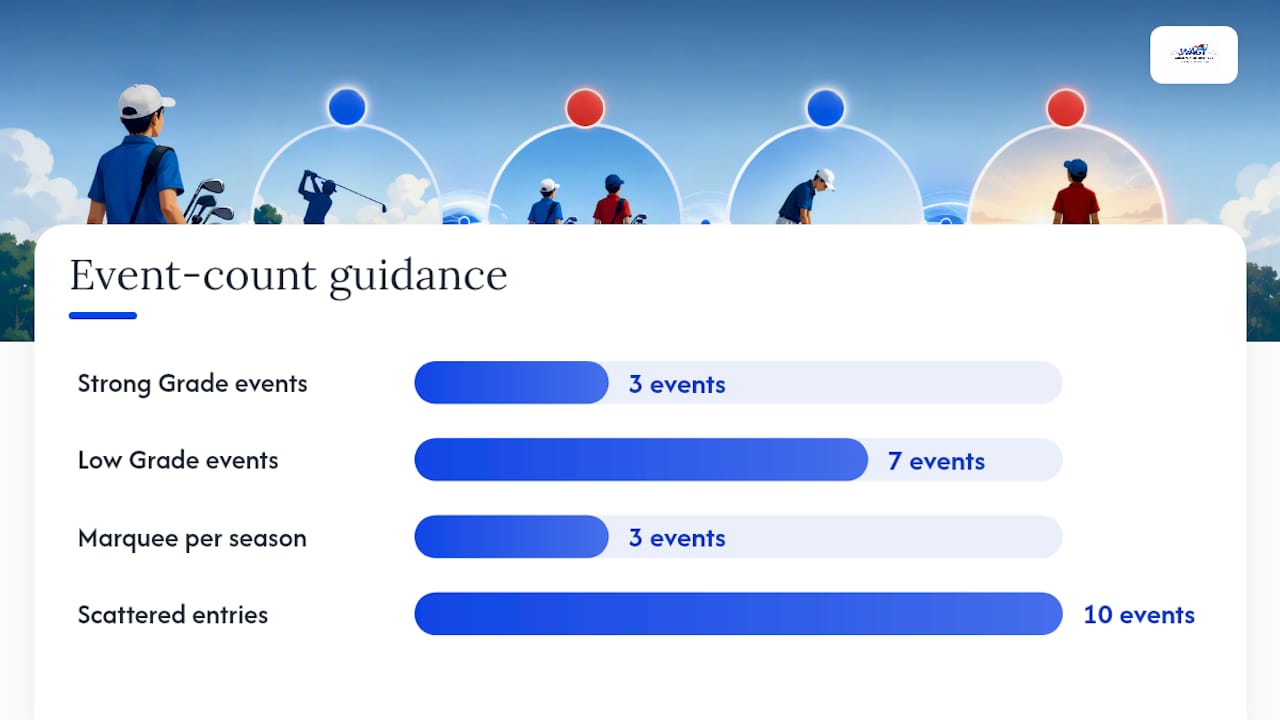
Step 2: Target higher-grade fields over higher event counts. Given how the divisor system works, three Grade 2–3 events with strong fields typically do more for your ranking than seven Grade 6 events. Quality of field, not quantity of entries, moves the needle.
Step 3: Estimate points-per-event before committing. Look at a tournament's past strength of field and its assigned grade, then weigh that against travel cost and time away from school. A Grade 2 event six hours away can be worth more than a Grade 5 event down the street.
Step 4: Spread strong results across the full 104-week window. A ranking built on three great tournaments back to back and then silence for a year fades fast. Consistency across the window protects your average as older results roll off.
- Prioritize events with fields you can research in advance
- Budget travel around two or three marquee events per season, not ten scattered ones
- Keep at least one lower-grade event on the calendar purely for reps and confidence, especially after a swing change or injury layoff
Pro Tip: Before booking travel, pull the prior year's final leaderboard for the event you're considering. If the top of that leaderboard is full of unfamiliar names from weak local circuits, the field strength probably will not justify the grade on paper.
How World Amateur Golf Tour Membership Supports Your WAGR Goals
Membership programs exist to remove the guesswork from the process described above. Instead of chasing down individual tournament organizers to confirm setup rules, members get access to professionally run events built from the ground up to meet WAGR's teeing and field-size requirements.
That matters more than it sounds. Managing tee assignments and field minimums carefully prevents junior divisions from receiving shortened setups by accident, avoiding oversights that can strip a tournament of its ranking value.
Beyond entry access, membership can include tools built specifically for the recruiting side of the equation:
- Live scoring during events, so results can be visible in real time to coaches and family
- Ranking tracking that shows where a player stands and how upcoming events might shift that position
- Player profiles that present tournament history in a format college coaches can review quickly
- Recruiting tools designed to put verified results in front of college programs
For a family trying to build a WAGR-counting tournament schedule, a membership that bundles sanctioned events with tracking and recruiting exposure can remove several separate headaches at once. You can review membership details and current event listings directly on the World Amateur Golf Tour site.
Getting Started: Your Pre-Entry Checklist
Before a single entry fee gets paid, a handful of documents and confirmations save families real money and real frustration down the line.
- Build a player profile. Have proof of age, a current handicap index, and membership status (if applicable) ready before registration opens.
- Budget the full cost, not just the entry fee. Factor in membership dues, tournament entry, travel, lodging, and any coaching or caddie costs tied to the trip.
- Track registration windows closely. Popular Grade 1–3 events fill fast, and late entries sometimes land in a secondary field that does not carry the same points.
- Confirm results-reporting timelines. Ask how quickly the organizer submits scores for WAGR processing, since a delayed submission can push a good result outside the ranking window you were counting on.
- Ask the organizer four direct questions: What grade is this event? What tees does each division play? What is the confirmed field size? How and when are results submitted to WAGR?
Families who ask those four questions before registering rarely end up with a wasted entry fee.
Rankings Are a Tool, Not the Whole Plan
Chasing a number can quietly hijack a junior's development if nobody in the family steps back to check the bigger picture. WAGR is genuinely useful. It gives coaches a two-year window of verified performance instead of a single hot summer, and that longer view rewards players who compete consistently rather than players who peak once and coast.
But a ranking is a byproduct of good golf, not a substitute for it. I'd rather see a player skip a marginal Grade 6 event to work on a swing flaw than enter it purely to keep a number moving. The players who hold up under college pressure are the ones who treated every counting event as a real competition, not a ranking transaction.
Use WAGR to guide scheduling decisions. Do not let it make every decision for you.
— Gene
Join World Amateur Golf Tour and Start Earning WAGR Points
Membership options exist so that families spend less time chasing sanctioning details and more time playing golf that actually counts. Such memberships can connect juniors and collegiate players to professionally run, WAGR-counting events, with live scoring, ranking tracking, and recruiting-ready player profiles integrated into the platform.

If you have been piecing together a schedule from scattered tournament websites and hoping the field size holds up, this is the more direct route: one membership, a slate of WAGR-sanctioned events built to meet current teeing and field requirements, and results tracking that puts your performance in front of college coaches without extra paperwork on your end. Visit World Amateur Golf Tour to check current event listings, review membership options, and get your next tournament on the calendar.
Where to Verify WAGR Rules and Event Eligibility
Every claim in this article traces back to sources you can check yourself before entering an event. Start with The R&A's official WAGR page for ranking scope and authority, then review the WAGR FAQs for the rolling window and divisor math.
For grading mechanics, Golforbis's breakdown of how WAGR works walks through the 1 through 7 grading scale in detail. The USGA's WAGR explainer covers why coaches lean on the ranking during recruiting. Before entering any event, check its listing status directly or ask the organizer to confirm sanctioning in writing.
Sources
- WAGR FAQs
- The R&A — World Amateur Golf Ranking
- World Amateur Golf Ranking: How it works — Golforbis
- USGA — What is WAGR? (2026 explainer)
FAQ
What Does Mid-Amateur Mean in the WAGR Junior Pathway?
In this context, it refers to the WAGR-based ranking pathway that elite junior and collegiate golfers use to build a verified competitive record for college recruiting, not adult amateur golf.
How Do I Know if a Junior Tournament Counts Toward WAGR?
Confirm the division plays championship-length tees and meets current field-size minimums (16 for male/mixed events, 8 for women's events), then verify sanctioning directly with the organizer or the official WAGR event listing.
How Often Does WAGR Update Rankings?
WAGR uses a rolling 104-week window and publishes ranking updates on a regular basis, with your average adjusting as older results age out and new results post.
Why Would Playing More Tournaments Hurt My WAGR Ranking?
Because WAGR averages points across a divisor tied to your number of counting events, adding weak results to a strong record can lower your overall average instead of raising it.
Does World Amateur Golf Tour Help With College Recruiting Exposure?
Yes. Membership includes player profiles, live scoring, and ranking tracking designed to present verified tournament results to college coaches during recruiting.