

A cut in a golf tournament is the score threshold set after 36 holes that determines which players advance to the weekend rounds and which are eliminated from competition. Players who score at or below the cut line continue playing. Players above it go home with no prize money and no ranking points. The PGA Tour and DP World Tour both use this elimination process to manage large fields and protect competitive integrity. Understanding golf tournament cut rules gives you a real edge, whether you are watching on TV or competing yourself.
What is a cut in golf tournament play and how is it set?
The cut line is defined as the score of the player ranked at a specific position after two rounds of stroke play, and every player tied at that score also advances. On the PGA Tour, the standard cut rule is the top 65 players and ties after 36 holes. That "and ties" clause matters more than most players realize.
Here is how the process works, step by step:
- All players complete rounds one and two.
- The tournament committee ranks every player by total score.
- The score of the player in 65th place becomes the cut line.
- Every player tied at that score also advances, regardless of how many players that adds to the field.
- Players ranked 66th or worse are eliminated.
Because of ties, weekend fields typically expand to anywhere from 65 to 80 players. A tight leaderboard with many players at the same score can push the field well past 65. The cut line is not fixed before the tournament. It shifts dynamically throughout day two as players complete their rounds, which is why projected cut lines fluctuate on scoreboards and broadcasts all Friday afternoon.
Players who miss the cut receive no prize money from that event. They also earn no FedExCup or OWGR points, which directly affects their season standing and tour card status. Missing cuts repeatedly can cost a player their PGA Tour card.

Pro Tip: Watch the projected cut line during Friday's second round. When a player is sitting right on the number, their shot selection and risk tolerance change visibly. That is golf tournament pressure at its most raw.
How do cut rules differ across major championships?
Major championships apply stricter cut criteria than standard tour events. The differences are significant and affect both field size and competitive strategy heading into the weekend.
| Championship | Cut Rule |
|---|---|
| The Masters | Top 50 and ties |
| U.S. Open | Top 60 and ties |
| PGA Championship | Top 70 and ties |
| The Open Championship | Top 70 and ties |
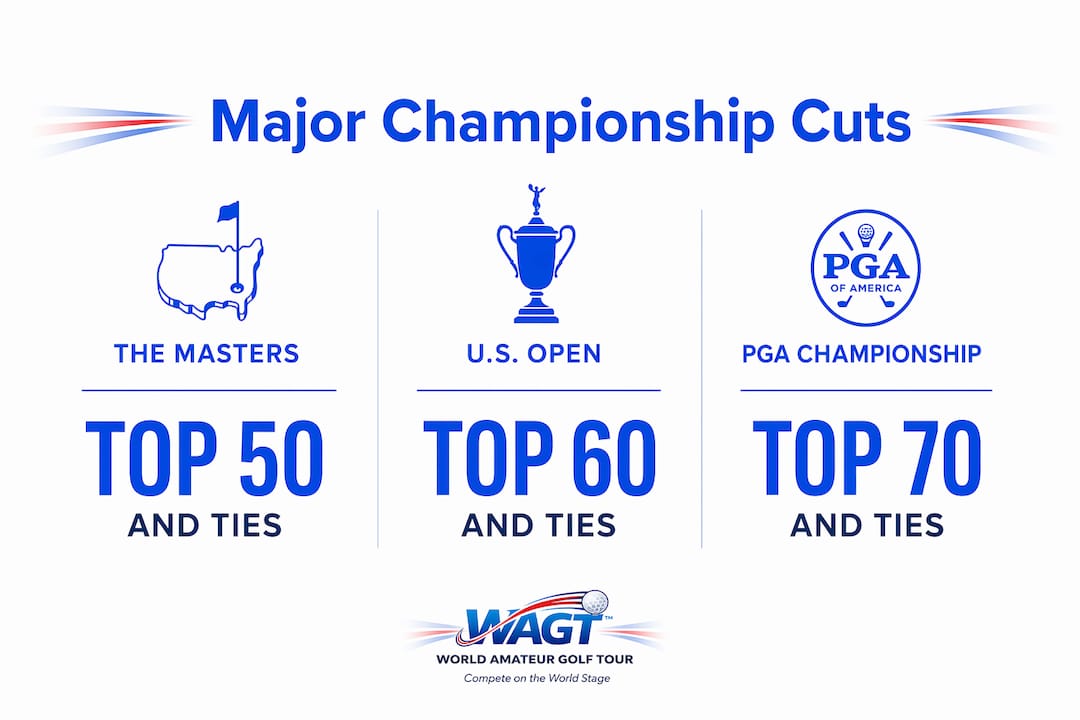
The Masters cuts the field most aggressively, advancing only the top 50 players and ties. That produces a tight, elite weekend field at Augusta National. The U.S. Open advances the top 60 and ties. Both the PGA Championship and The Open Championship use the top 70 and ties, which results in larger weekend fields more comparable to regular tour events.
One major historical change reshaped how these cuts work. The "10-shot rule" once allowed any player within 10 strokes of the leader to make the cut regardless of their position on the leaderboard. The 10-shot rule was abolished to create a stricter, merit-based process. The U.S. Open removed it starting in 2012. The Masters followed in 2020. This shift moved the focus from proximity to the leader toward consistent scoring across both rounds.
The practical effect is significant. A player who shoots a brilliant first round but struggles in round two can no longer rely on a hot leaderboard to carry them through. You have to earn your weekend spot on your own scorecard, full stop.
Pro Tip: At the Masters, the top 50 and ties rule means the cut line is often several strokes under par. If you are tracking a player's chances, compare their score to the field average after round one, not just the leader.
Why do tournaments use cuts at all?
Cuts exist because professional golf tournaments begin with large fields that cannot practically compete across four full rounds. A typical PGA Tour event starts with 120 to 156 players. Running all of them through four rounds would create scheduling problems, slow pace of play, and a viewing experience that loses focus.
Cutting to 65 players after 36 holes solves several logistical problems at once:
- Weekend rounds finish on schedule without needing two-tee starts for an oversized field.
- Pace of play improves significantly with fewer groups on the course.
- TV coverage can focus on the contenders rather than spreading thin across 150 players.
- The competitive narrative sharpens because only the best performers remain.
Cuts also create a unique pressure point that does not exist in most other sports. A player can have a brilliant career week and still go home Friday evening if their scoring does not hold up. That pressure produces some of golf's most compelling moments. You can read more about how golf event scheduling connects to cut rules and tournament structure.
The PGA Tour's decision to eliminate secondary cuts, which once trimmed fields again after 54 holes, also reflects this logic. One clean cut after 36 holes keeps the format simple and fair. Players know exactly where they stand and what they need to do.
What are the financial and career stakes of making the cut?
The financial gap between making and missing the cut is concrete and immediate. At the 2025 Open Championship, the minimum payout for making the cut was $37,650. Players who missed the cut received $12,350. That difference of more than $25,000 comes from a single round of golf on Friday.
The career implications go well beyond one paycheck. Players who miss the cut also lose out on:
- FedExCup points, which determine playoff eligibility and season-long bonuses.
- Official World Golf Ranking (OWGR) points, which affect world ranking position and major championship exemptions.
- Sponsor exemption opportunities, since sponsors favor players with strong cut records.
- Tour card security, since consistent missed cuts threaten a player's status for the following season.
For players on the bubble of tour status, a missed cut is not just a bad week. It is a data point that follows them through the season. Players near the cut line on Friday afternoon are not just playing for that week's check. They are protecting their ranking, their exemptions, and their livelihood. Understanding this context changes how you watch the game entirely.
The psychological weight is real, too. The cut line represents a high-stakes moment unique to professional golf, and Friday afternoon is when careers can quietly shift direction. A player who makes the cut and finishes 40th still earns points and money. A player who misses by one shot earns nothing and loses ground on every metric that matters.
Key Takeaways
The cut in golf is a merit-based elimination threshold set after 36 holes that separates weekend competitors from eliminated players, with financial and ranking consequences that make it one of the most consequential moments in professional tournament golf.
| Point | Details |
|---|---|
| Standard PGA Tour cut rule | Top 65 players and ties advance after 36 holes; all others are eliminated. |
| Major championship cuts | Masters uses top 50, U.S. Open top 60, PGA and The Open top 70, all including ties. |
| Weekend field size varies | Ties at the cut score can expand the weekend field from 65 to as many as 80 players. |
| Financial stakes are immediate | At the 2025 Open Championship, making the cut paid at least $37,650 versus $12,350 for missing it. |
| Missing the cut costs ranking points | Players who miss earn zero FedExCup and zero OWGR points, threatening tour card status. |
The cut line is where tournament golf gets real
I have watched a lot of competitive golf, and the cut line is the moment I find most revealing about a player's character. It is not the Sunday back nine that tells you who a player really is. It is Friday at 4:00 PM, when they are sitting one shot outside the number and have to decide whether to attack a tucked pin or play safe to the fat part of the green.
Most casual fans focus on the leaders. Serious players and students of the game watch the cut line. That is where you see who can manage pressure, who has the mental discipline to grind through a tough second round, and who falls apart when the stakes are clear and immediate.
One thing I think gets overlooked is how the abolishment of the 10-shot rule changed player strategy. Before that change, a player who went low in round one could afford a sloppy round two and still survive on proximity to the leader. Now, you have to earn it on your scorecard. That shift rewards consistent ball strikers and penalizes players who rely on one great round to carry them. It made the cut a purer test of performance.
For amateur players serious about developing their game, understanding the cut is not just trivia. It is a framework for thinking about tournament preparation, round-by-round scoring targets, and the mental discipline required to compete at any level. If you want to perform under pressure, you need to practice under conditions that create it.
— Gene
Compete under real tournament conditions with Worldamateurgolftour
Knowing how cuts work is one thing. Competing under those conditions is another level entirely.

Worldamateurgolftour runs WAGR-certified events that mirror professional tour formats, including cut-based competition structures at championship-caliber courses. Junior, collegiate, and amateur players earn Official World Amateur Golf Ranking points in a fair, transparent environment built for serious competition. If you want to experience the pressure of a real cut line and build the tournament record that opens doors to collegiate and professional golf, register for a WAGR event with Worldamateurgolftour. Your next competitive round could be the one that changes your trajectory.
FAQ
What is the cut line in golf?
The cut line in golf is the score threshold set after 36 holes in a stroke-play tournament. Players at or below that score advance to the weekend rounds; players above it are eliminated.
How does the cut work in major championships?
Major championships use stricter cut rules than standard events. The Masters advances the top 50 and ties, the U.S. Open the top 60 and ties, and both the PGA Championship and The Open Championship the top 70 and ties.
What happens if you miss the cut in golf?
Players who miss the cut are eliminated from the tournament and earn no prize money, no FedExCup points, and no Official World Golf Ranking points for that event.
Why was the 10-shot rule removed from major championships?
The 10-shot rule, which allowed players within 10 strokes of the leader to advance regardless of position, was removed to create a merit-based cut process focused on consistent scoring rather than proximity to the lead.
Can the weekend field be larger than 65 players on the PGA Tour?
Yes. Because the cut rule includes all players tied at the 65th-place score, the weekend field can expand to 75 or 80 players when multiple players share that threshold score.