

Yes, many U.S. collegiate events count toward the World Amateur Golf Ranking, but only when the event is officially listed as a Counting Event. Do not assume your school's schedule automatically qualifies. Before you build a season plan around it, search the WAGR Men's or Women's event database and confirm that specific tournament shows Counting Event status, rounds, and dates.
TL;DR:
- WAGR points at college events depend on the event's Power rating, field strength, and your finishing position, with winners at high-Power events earning up to around 25 points.
- Only events listed as Counting Events in the official WAGR database, verified through the event page, qualify for ranking points, not all college tournaments or team match-play events.
- To qualify as a WAGR-ranked player, you must play at least 36 holes in a recognized event and finish first or earn at least 6.5 Ranking Points without disqualifications or team formats.
- When choosing events, ensure the format aligns with the 36-hole minimum, verify the Power rating suits your skill level, and confirm registration and travel plans beforehand.
- Joining a dedicated tour like World Amateur Golf Tour provides consistent access to WAGR-counting tournaments at top venues, simplifying the process of building a competitive schedule.
Table of Contents
- Where To Find College Events WAGR Recognizes
- How WAGR Points and Event Power Actually Work
- What Are the WAGR Ranked-Player Eligibility Rules?
- How Do You Choose and Register For the Right Events?
- Why This Matters Beyond the Ranking Number
- A Publisher's Perspective on Supporting Junior and College Players
- Get Direct Access To WAGR-Counting Events
- Sources
- FAQ
Where To Find College Events WAGR Recognizes
Every ranked event lives in one place: the official WAGR event database. That is your starting point, not a golf schedule you found on a school athletics page or a third-party listing site.
- L'IA…
Here's how to check it correctly:
- Open the Men's or Women's Events section and filter by date range or region.
- Look for a "Collegiate" tag or explicit Counting Event marker on the listing.
- Click into the event page and check the format, number of rounds, and Power rating.
- Note the organizer name and contact, since you'll need that for registration and verification later.
- Bookmark the results page so you can reference it once the event finishes.
The WAGR event database shows this information directly on each event page, which is the only reliable way to confirm status. Real-world examples back this up. The 2026 Defiance College Fall Invite appears as a listed WAGR event, alongside numerous other U.S. Collegiate Golf tournaments run throughout the fall and spring seasons. If your event isn't showing up in that database under the right category, treat it as non-counting until proven otherwise.
How WAGR Points and Event Power Actually Work
Points depend on three things working together: event Power, field size, and where you finish. Power reflects the strength of the field, calculated from the rankings of the players entered, and it scales how many points are available at that specific tournament.
A few things to keep in mind before you get excited about a big-name event:
- Winners at lower-Power events might earn only a small number of points.
- Winners at high-Power amateur fields can earn significantly more points.
- A strong finish at a weak-field event may earn you fewer points than a mid-pack finish at a stacked one.
- Power alone does not guarantee points. Field size and your actual finishing position determine the real number.
Statistic Callout: According to WAGR's own scoring criteria, winners at the lowest-Power events may receive around 5.3 points, while winners at the highest-Power amateur events can earn up to roughly 25 points. That is nearly a five-fold swing based entirely on field strength, not effort or performance.
The lesson here is straightforward: two wins are not created equal. A trophy from a weak field looks the same on paper as one from a loaded field, but the ranking impact is nowhere close.
What Are the WAGR Ranked-Player Eligibility Rules?
Earning points at one event doesn't automatically make you a WAGR Ranked Player. There's a specific test you have to clear first.
- Play at least 36 holes in a Counting Event. Anything shorter doesn't qualify, regardless of how well you play.
- Finish alone in first place, or land in a position worth at least 6.5 Ranking Points. Either condition satisfies the ranked-player criteria.
- Avoid disqualifying outcomes. Withdrawals, retirements, disqualifications, and team match-play results do not count toward this test, even if you played well before the issue occurred.
- Confirm with your coach or the tournament organizer, before the event, whether it's an individual Counting Event or a team format that won't apply here.
That last step matters more than most players realize. A college season is full of team match-play events that feel competitive and important, but they contribute nothing to your individual WAGR status. Know which events on your schedule actually count before you build expectations around them.
How Do You Choose and Register For the Right Events?
Picking events is where most players get strategic planning wrong. More entries do not mean more points. A realistic fit between your current game and an event's Power rating matters far more than stacking your calendar with tournaments.
Build a Prioritization Framework First
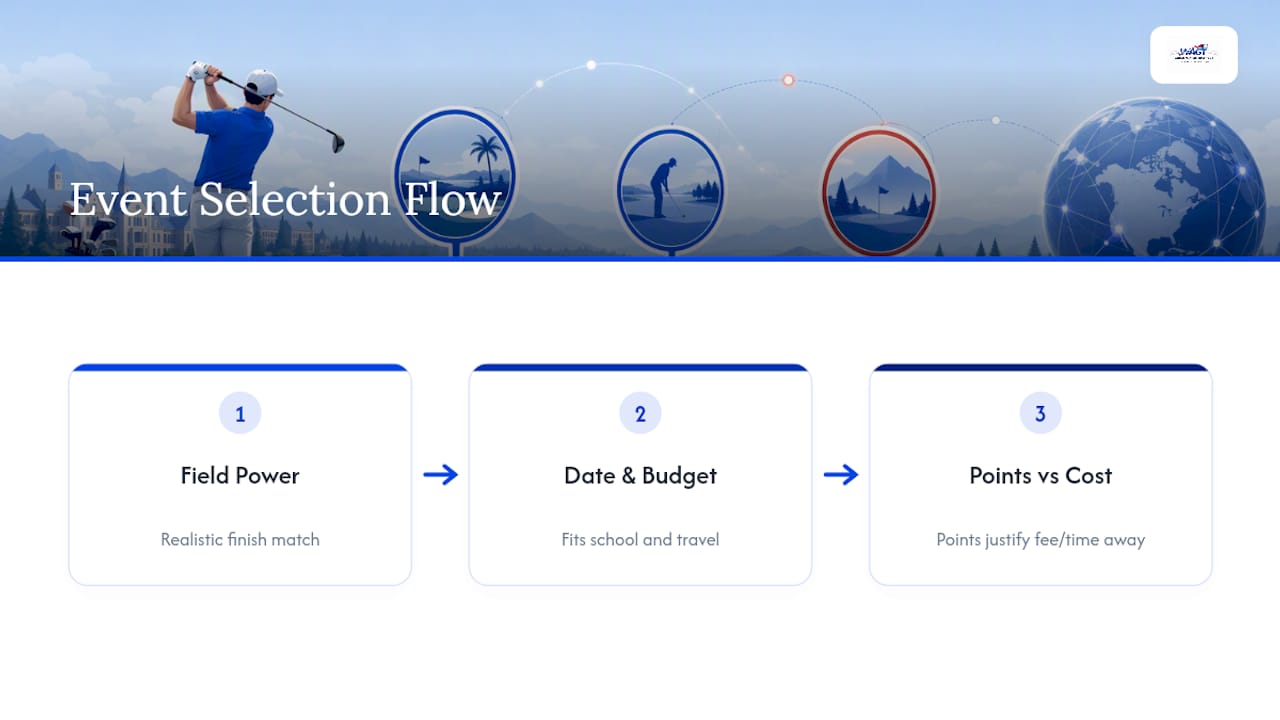
Ask three questions before committing to any event: Does the field Power match a finish you can realistically achieve? Does the date fit your school schedule and travel budget? Does the potential point gain justify the entry fee and time away from practice or class? Skipping this step is how players end up chasing quantity over quality, entering five mediocre-fit events instead of two that actually move their number.
Registration Steps That Protect Your Investment
Once you've identified a target event, work through this checklist:
- Find the event page in the WAGR database and confirm Counting Event status one more time.
- Verify the format and number of rounds, since a shortened event might not meet the 36-hole minimum.
- Register directly through the organizer's platform, not a third party.
- Confirm your entry, payment, starting position, and the cancellation policy before finalizing travel.
- Check the entry process for World Amateur Golf Tour events if you're considering a WAGT-hosted tournament specifically.
Travel and Roster Considerations
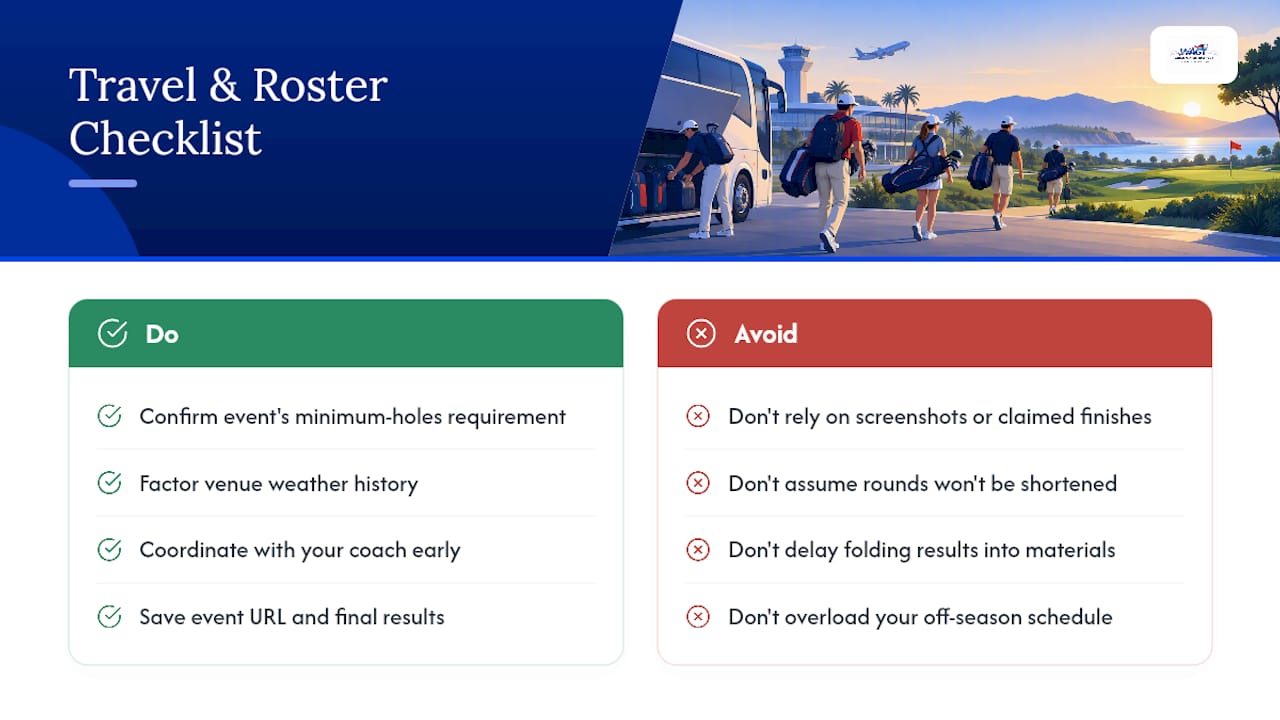
Confirm the minimum-holes requirement applies to the specific format you're entering, and factor in weather history for the venue. A tournament with a track record of weather-shortened rounds carries real risk of falling short of the 36-hole threshold. Coordinate with your coach early so official results can be folded into your recruiting materials and season summary the moment the event finishes.
Pro Tip: Save the WAGR event URL and the final results page the day the tournament ends. Coaches and recruiters trust a verifiable link far more than a screenshot or a claimed finish, and event pages sometimes get archived or reorganized months later.
For players managing gaps between semesters, the off-season competition guide covers how to keep your ranking active without overloading your schedule. And if you want a curated starting list rather than searching the full database cold, the guide to WAGR-counting amateur tournaments breaks down strong U.S. options by region and season.
Why This Matters Beyond the Ranking Number
A WAGR result is not just a number on a leaderboard. PGA TOUR University draws on eligible NCAA Division I men's competitions and selected professional events, and players may need roughly 20 points by the end of their third year of NCAA eligibility to access certain pathway opportunities. That means the events you choose during your college years can echo well past graduation, shaping options you won't fully appreciate until you're closer to turning pro.
A Publisher's Perspective on Supporting Junior and College Players
We built the World Amateur Golf Tour around a simple frustration we kept hearing from junior and college golfers: too many WAGR-counting opportunities require expensive travel just to get meaningful reps in front of a strong field. Our tournaments run at championship-caliber venues, and every event is designed with player development and fair competition as the priority, not an afterthought squeezed around a bigger production. Membership gives you consistent access to professionally run, WAGR-counting events, plus tools to help track and share your playing history with recruiters.
— Gene
Get Direct Access To WAGR-Counting Events
Here's the practical advantage of joining Worldamateurgolftour instead of piecing together a schedule from scattered listings: you get a built-in pipeline of professionally run, WAGR-counting tournaments at championship-level venues, without hunting through databases event by event or gambling on unfamiliar organizers.

The Annual Membership gives you structured access to tournaments and series designed for junior and collegiate golfers chasing ranking points and a stronger player resume. Membership also includes player profile tools that can help organize and present your competition history clearly to coaches or recruiters. If you're ready to stop guessing which tournaments actually move your ranking, visit the World Amateur Golf Tour membership page to see current events and start your registration.
Sources
Verify every event yourself using the WAGR FAQs, the WAGR eligibility criteria, and PGA TOUR University's ranking criteria for pathway context. For compliance details on how organizers earn Counting Event status, see how golf events comply with WAGR rules.
FAQ
Do All College Golf Tournaments Count Toward WAGR?
No. Only events listed as Counting Events in the official WAGR database count, and many regular-season college matches, especially team match-play formats, do not qualify regardless of competitive level.
How Many Points Can You Earn From a College Event?
It depends entirely on the event's Power rating, field size, and your finish. Winners at low-Power events may earn around 5.3 points, while winners at the highest-Power amateur fields can earn up to roughly 25 points.
What Counts as a Qualifying Finish for WAGR Ranked-Player Status?
You need at least 36 holes played and either an outright win or a finish worth 6.5 Ranking Points or more, per the WAGR eligibility criteria. Withdrawals, retirements, disqualifications, and team match-play results don't satisfy this test.
Does Worldamateurgolftour Offer WAGR-Counting Events for College Golfers?
Yes. Worldamateurgolftour runs WAGR-counting tournaments through its event calendar and the WAGT Ascension Series, both included with the 2026 Annual Membership. Current pricing and event details are available on the membership page.
How Do I Verify an Event Before Paying Entry Fees and Booking Travel?
Open the event's page in the WAGR database and confirm its Counting Event status, format, and round count before spending a dollar on travel. Always double check with the organizer directly if the listing looks incomplete or outdated.