

To become a Ranked Player, you need to play at least 36 holes in an approved Counting Event and either finish alone in first place or earn at least 6.5 Ranking Points. Every Counting Event must be approved by the WAGR Committee and meet strict technical standards set by The R&A and USGA. The two changes that matter most right now: minimum field sizes jumped for men's and mixed events, and low-Power events now award fewer points than before.
TL;DR:
- Field sizes for men's and mixed Counting Events now require a minimum of 16 players, raising the level of competition needed to count toward ranking points.
- Winning outright in a Counting Event guarantees ranked status regardless of the event's Power rating or field size.
- Events with a Power rating of 50 or less now award fewer points, emphasizing the importance of strong fields for ranking development.
- Only events that meet strict technical standards, including course setup and rule compliance, are eligible to count, making event verification crucial beforehand.
- Players' amateur status and proof of event approval significantly impact their ability to earn and maintain WAGR ranking points.
Table of Contents
- What Qualifies as a WAGR Counting Event
- How a Player Becomes a Ranked Player
- Event Technical Requirements for Course and Rules Compliance
- Event Power, Points Allocation, and What the Committee Changed
- How Organizers Register Events and Players Verify Results
- Eligibility Criteria for Players to Participate in WAGR Events
- Restrictions Tied to Handicap and Ranking Status
- Role of Amateur Status and Its Impact on Eligibility
- How Eligibility Varies by Region and Tour Level
- Why the Field-Size Changes Matter More Than They Look
- Play WAGR-Counting Events With World Amateur Golf Tour
- Sources
- FAQ
What Qualifies as a WAGR Counting Event
Not every tournament on your schedule builds your ranking. A Counting Event has to be an elite competition, and the format matters as much as the field.
The World Amateur Golf Ranking recognizes several formats as eligible, provided each one clears the Committee's technical bar:
- Individual stroke play events with gross scoring returned for every player
- Match play championships, including bracket-style knockout formats
- Team match play events, such as Ryder Cup style competitions
- Select professional events that accept amateur entries and return amateur scores separately
Gross scoring is non-negotiable. If an event returns net scores adjusted by handicap, it cannot count toward WAGR, because the ranking measures actual playing ability, not handicap-adjusted performance. That is why so many club-level and member-guest events, however competitive, never touch the ranking.
Scheduling matters too. Events generally need to run on consecutive days, and there is a cap on total tournament length that keeps the format aligned with what a "championship" actually looks like. Multi-division tournaments, where different age or gender categories play simultaneously, can still count as long as each division that returns results plays from the same tees and meets the field requirements on its own. A 54-hole junior boys division running alongside a 54-hole girls division at the same course, for example, can both be Counting Events if each satisfies the criteria independently.
How a Player Becomes a Ranked Player
Ranked status is not automatic just because you entered a good tournament. It comes down to three specific conditions, and understanding them changes how you pick events.
- Play at least 36 holes. Anything shorter, even in a legitimate Counting Event, will not establish ranked status on its own.
- Finish alone in first place, which grants ranked status regardless of how many Ranking Points that particular finish generated. This is the sole-winner exception, and it is the fastest documented path onto the list.
- Earn at least 6.5 Ranking Points in a single Counting Event if you did not win outright. Points are calculated from your finishing position weighted against the event's Power, so a runner-up finish at a high-Power national championship can clear that threshold, while the same finish at a thin regional event might not.
Team events work differently. Rather than scoring purely on individual placement, players earn participation points tied to the event's overall Power rating, since team formats do not always produce a clean individual leaderboard. A player on a strong national team squad can still accumulate meaningful points even without an individual top finish, which is worth knowing if your season includes state or interclub team competition.
Event Technical Requirements for Course and Rules Compliance
Organizers carry the heavier lift here, but players benefit from knowing what separates a real Counting Event from a tournament that looks the part but will not survive Committee review.
Every event must comply with:
- The Rules of Golf as maintained by The R&A and USGA
- The Rules of Amateur Status, which govern who can compete without forfeiting eligibility
- The Equipment Rules enforced by both governing bodies
Course setup carries its own bar. WAGR requires a minimum 18-hole par of at least 64, a standard updated in May 2024 specifically to keep short, easy setups from inflating scoring and skewing point calculations. A 9-hole course can still qualify, but only on a pro rata basis, meaning its total par for two loops has to reach that same 64-par floor.
Championship tee placement is mandatory, meaning the longest, most demanding tee option available for the format and division. Events also need a minimum number of scheduled rounds per player, and any playoff or tie-break procedure has to be defined and applied consistently.
Pro Tip: Even small deviations from championship setup, like moved tee markers, altered hole locations, or a shortened course, can disqualify an otherwise strong field from counting. Ask the host club for written confirmation of tee yardages before the first round tees off.
Event Power, Points Allocation, and What the Committee Changed
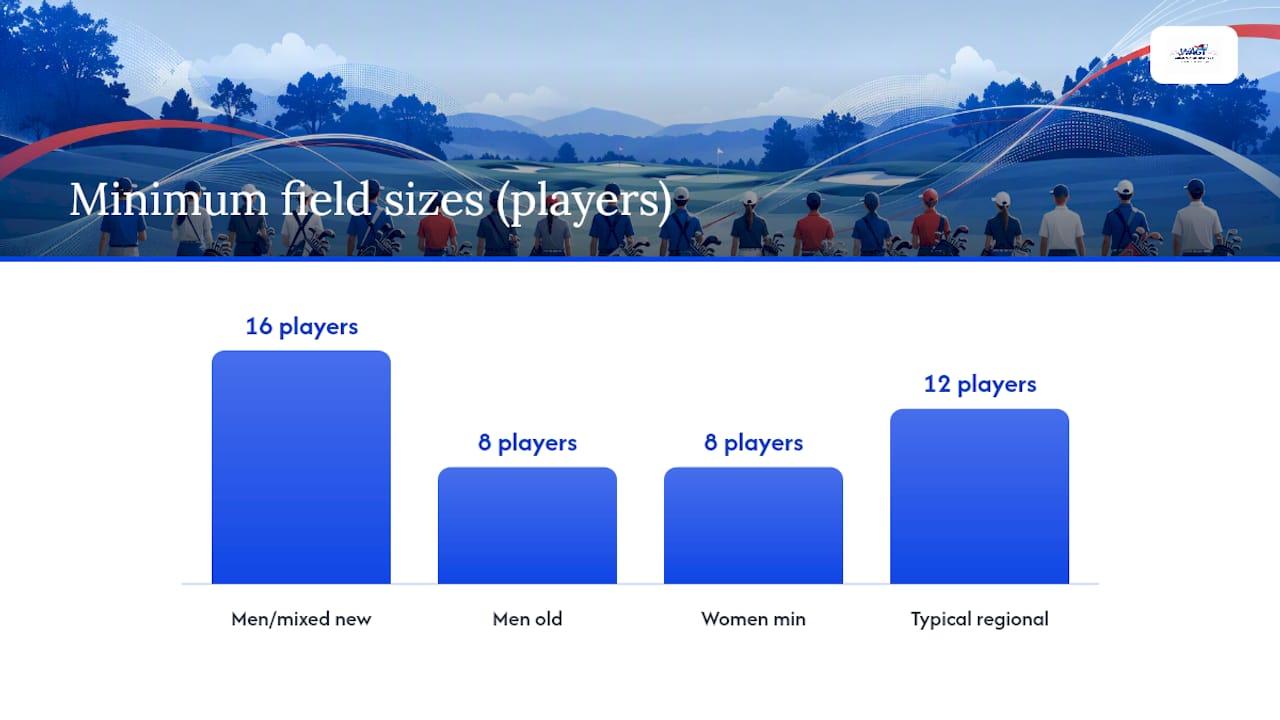
Event Power is the number that determines how many Ranking Points are available at a given tournament. A higher Power rating, driven mostly by the strength and depth of the field, means bigger point payouts for every finishing position, including well down the leaderboard. A thin field, even at a beautiful course, generates a low Power number and correspondingly small point allocations.
The Committee made two changes that reshaped the landscape starting January 1, 2025:
- Minimum field size for men's and mixed events rose from 8 to 16 players. Women's events remain at a minimum of 8.
- Events with a Power of 50 or less now award reduced points, a direct response to concerns that thin fields were inflating rankings without reflecting real competitive depth.
The field-size increase was designed to protect ranking integrity by ensuring Counting Events represent a genuinely competitive body of players, not just enough entrants to hit a technical minimum.
The practical fallout is straightforward: a 12-player regional event that used to count for men might not clear the field-size bar anymore, and a marginal event that does qualify could still hand out fewer points than it once did. The sole-winner exception has not changed. Win outright, and you become a Ranked Player regardless of the Power number attached to that event.
How Organizers Register Events and Players Verify Results
Getting a tournament recognized, and confirming it actually counts before you enter, follows a defined process on both sides.
- Organizers apply through the WAGR Event Organiser Registration process, submitting course details, field projections, and format information for Committee review. Approval is not automatic. The Committee evaluates each submission annually against the technical criteria.
- Results must be returned directly to WAGR after the event concludes, along with accurate player information forms. Nationality data matters here more than most players realize, since it determines which national list a result feeds into.
- Players should confirm counting status before entering, not after. Ask the organizer directly whether the event has current Committee approval, and check the expected field size and Power projection if it is published.
- Cross-check the entry process against your own WAGR profile to make sure your player information is current before results get returned.
Organizers do not need to mirror their national federation's Order of Merit rules to get WAGR approval. Meeting WAGR's own technical criteria, gross scoring and championship setup among them, is sufficient on its own for submission and consideration.
Eligibility Criteria for Players to Participate in WAGR Events
Player eligibility for WAGR events runs on two tracks: eligibility to enter the tournament itself, and eligibility for that performance to actually generate ranking points.
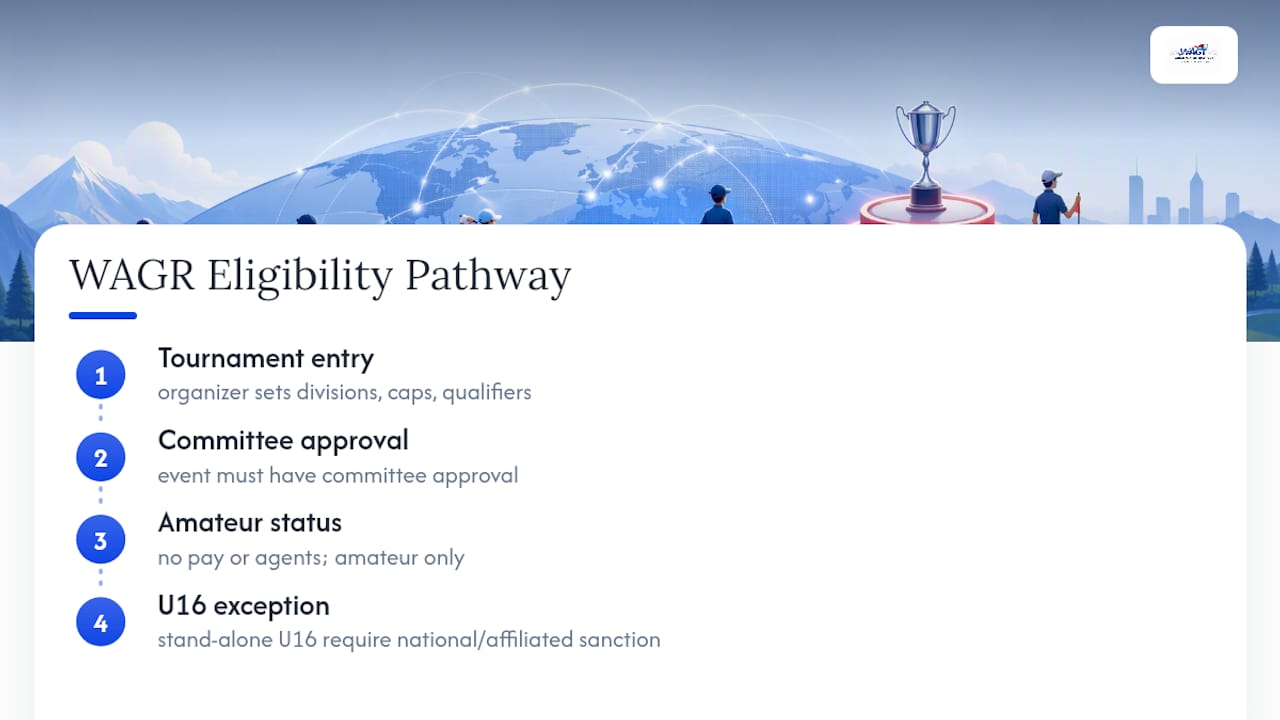
Entry eligibility is usually set by the individual tournament organizer, not by WAGR directly. Age divisions, handicap caps, and qualifying rounds are all decision points organizers control. WAGR's role kicks in after you tee it up: as long as the event has Committee approval and you meet the amateur status requirement, your results count on the same terms as everyone else in the field.
Amateur status is the one universal filter that applies everywhere. Under Rules of Amateur Status, any player who has accepted payment for playing golf, signed with an agent for competitive purposes, or otherwise crossed into professional status loses standing on the amateur ranking entirely. There is no partial credit. Once professional status is triggered, results stop counting toward WAGR regardless of how strong the finish was.
Junior, public links, mid-amateur, and senior divisions are all included when the event itself qualifies as elite for that category and clears the general WAGR criteria. Stand-alone under-16 events are the one notable exception. They typically do not count unless they are conducted at the national level or sanctioned by an affiliated national governing body, which is worth flagging for parents scheduling a 14 or 15-year-old's season.
Restrictions Tied to Handicap and Ranking Status
WAGR itself does not impose a handicap ceiling for a result to count. That restriction, when it exists, comes from the individual tournament, not from the ranking system. Some organizers cap entry at a certain handicap index to keep the field competitive; others run open qualifying with no handicap restriction at all. Check the specific event's entry conditions rather than assuming a universal WAGR rule applies.
Where ranking status does matter is in exemption categories. Many national championships use a player's current WAGR standing, not their handicap, as a gatekeeper for entry into limited fields. The USGA uses Event Power and player ranking data when setting exemption categories for national championships, and those exemptions are frequently based on rolling three-year Power averages rather than a single strong season. That means a player chasing an exemption spot needs sustained results across multiple Counting Events, not one great week.
This creates a practical tension for juniors: a single breakout win can trigger ranked status immediately, but climbing high enough for exemption-level recognition usually takes a longer run of consistent, high-Power performances. Both paths matter, but they operate on different timelines, and a season plan should account for both.
Role of Amateur Status and Its Impact on Eligibility
Amateur status is the foundation everything else in this article sits on top of. Without it, none of the Counting Event rules, points thresholds, or field-size requirements apply to you at all.
The Rules of Amateur Status, jointly maintained by The R&A and USGA, define what disqualifies a player from amateur competition. Accepting prize money above defined limits, signing endorsement deals tied to competitive performance, or working as a golf professional in a teaching or club capacity are among the common triggers. The rules are detailed enough that players occasionally lose amateur status without fully realizing it happened, particularly around equipment sponsorship or paid instruction work.
For junior and collegiate golfers eyeing a WAGR-driven pathway toward college recruiting, protecting amateur status is not a background detail. It is the gate everything else passes through. A single technical violation can zero out a season's worth of ranking progress, even if every individual tournament result was otherwise clean. Coaches and parents managing a junior's schedule should treat amateur status compliance with the same seriousness as tee times and travel logistics.
How Eligibility Varies by Region and Tour Level
WAGR is a global ranking, but the events that feed it are approved on a case-by-case basis, which means eligibility in practice looks different depending on where and at what level you play.
National-level championships, run by a country's golf federation, tend to have the field depth and Power ratings that generate substantial points almost automatically. Regional and state-level tours vary more. Some regional circuits have built consistent, high-Power events over years of Committee approval, while others run thinner fields that clear the minimum bar but generate modest points. This is precisely why the 2025 field-size increase mattered so much for mid-tier regional tours: events that used to squeeze by with 8 to 10 entrants in the men's and mixed divisions needed to actively grow their fields to retain Counting Event status.
Junior-specific tours face an additional layer, since stand-alone under-16 events generally need national-level sanctioning to count at all. A well-run regional junior series can still fall outside WAGR recognition if it never clears that bar, which is a common surprise for families new to the ranking system. Reviewing an event's actual Committee approval status, rather than assuming reputation equals recognition, is the only reliable way to know where a given tour or region stands.
Why the Field-Size Changes Matter More Than They Look
The jump to a 16-player minimum for men's and mixed events is not a bureaucratic footnote. It directly raises the competitive bar for what counts as elite, and that has real downstream benefits for player development. A deeper field means every finishing position, not just first place, gets tested against genuinely tough competition, which makes the resulting points more meaningful to college coaches and national selectors reading your resume.
For juniors balancing travel budgets against tournament selection, this changes the math. A marginal regional event with a shrinking or borderline field is now a riskier bet than a slightly farther national-caliber tournament with a deep entry list. I would rather see a player travel for three high-Power events a season than chase six thin ones that may not clear the threshold at all.
For coaches and parents building a season calendar, my advice is simple: prioritize field strength and confirmed Committee approval over convenience, and build the schedule backward from two or three marquee events rather than forward from whatever is closest to home.
— Gene
Play WAGR-Counting Events With World Amateur Golf Tour
Finding tournaments that actually clear WAGR's technical bar, deep fields, championship tee setups, confirmed Committee approval, takes real research every single season. World Amateur Golf Tour removes that guesswork by running professionally managed, WAGR-counting events built specifically for junior, collegiate, and amateur golfers chasing legitimate ranking points.

Membership provides access to a calendar of sanctioned events, live scoring, and a player profile. If you are ready to start stacking WAGR points at courses built for serious competition, browse WAGR-ready tournaments or check current membership and event entry options to lock in your next start.
Sources
For rule text and future updates, go directly to the source rather than relying on secondhand summaries. Start with the WAGR Criteria page for the full technical standard, the WAGR FAQs for how ranked status is calculated, and the 2025 Criteria Updates release for the field-size and points changes. The USGA's WAGR explainer covers how national exemptions connect to ranking data. The Committee typically publishes criteria updates each autumn, so check that page every year before locking in your schedule.
FAQ
How do I get into WAGR?
You become a Ranked Player by playing at least 36 holes in an approved Counting Event and either finishing alone in first place or earning at least 6.5 Ranking Points.
What is the lowest WAGR ranking?
WAGR does not publish a fixed "lowest" number since the list expands and contracts based on how many players are actively ranked; a player only appears once they meet the 36-hole and points threshold described above.
Who is #1 in WAGR?
The top position changes regularly based on recent tournament results, so check the current WAGR standings directly for the latest number one rather than relying on a fixed name.
Has an amateur ever won a major?
Amateurs have made deep runs at major championships historically, but professional status typically separates amateur competitors from major-winning fields; WAGR tracks amateur performance specifically because those crossover moments are rare and closely watched.
Can you qualify for WAGR through junior tournaments?
Yes, if the junior event meets WAGR's Counting Event criteria and field requirements, though stand-alone under-16 events generally need national-level sanctioning to count.