

Most golf tournaments publish a firm registration open date and close date, and serious events layer priority windows on top for exempt or invited players before opening to the field. Expect first-come, first-served entry once the window opens, with waitlists and late-entry fees handling the overflow. Organizers should nail down the exact timestamp, time zone, refund terms, and late-entry rules before the window ever opens.
TL;DR:
- Registration opening times are usually set weeks or months in advance, with precise timestamps, especially for national or large-scale events, to avoid confusion across time zones.
- Exempt or invited players typically get early access through tiered windows, followed by regional qualifiers and then open registration, which remains first-come, first-served until full.
- Refund policies vary, but players should carefully check cutoff dates before registration, as refunds become less available closer to the event or once the field closes.
- Organizers must carefully select and test registration platforms, clearly communicate policies, and plan for traffic spikes during the opening minute to prevent technical failures.
- Event templates suggest club events open 4-6 weeks prior, regional tournaments 3-6 months out, and championships often employ multiple exemption tiers with registration closing just weeks before the event.
Table of Contents
- When Does Golf Tournament Registration Open and Close?
- How Do Priority Access and Exempt Windows Work?
- What Do Registration Fees, Refunds, and Waitlists Actually Cost?
- How Should Organizers Set and Publish Registration Dates?
- Three Registration Window Templates You Can Copy
- How Does World Amateur Golf Tour Manage Registration Windows?
- Balancing Open Access With Competitive Fairness
- Ready to Register for a WAGR-Counting Event?
- Sources
- FAQ
When Does Golf Tournament Registration Open and Close?
Timing depends almost entirely on the event's size and prestige. A local club scramble might open its registration window four to twelve weeks before the tee time, since the field is smaller and word travels fast through the membership. A regional amateur event usually opens three to six months out, giving traveling players time to book flights, hotels, and, in college-recruiting circles, coordinate with a coach's schedule.
The exact clock time matters more than most players realize. National-caliber events increasingly set precise opening timestamps, and one instructive example is the PDGA Pro Worlds registration schedule, which opens specific tiers at defined moments rather than a vague "sometime that week." A common pattern for events drawing entries from multiple time zones is an evening opening, often 8:00 PM or 10:30 PM Eastern, so West Coast players aren't locked out by a workday cutoff.
Where you find these details varies by event type:
- Club and municipal events typically post the open date and fee structure directly on the tournament's own event page, the way Virginia Beach's annual charity tournament lists its registration window alongside what the entry fee covers.
- Regional and championship events lean on dedicated registration platforms that display countdown timers and tier-specific rules.
- Member-driven tours send direct email or app notifications when a window opens, which matters if you're tracking a golf tournament sign-up deadline that isn't advertised widely elsewhere.
If you're building or refining your own event's timing, our guide on golf event field size walks through how capacity limits shape when you should open the gates.
How Do Priority Access and Exempt Windows Work?
Not every player enters through the same door. Tiered registration periods let organizers reward past performance and protect field quality before the general public gets a shot at open registration for a golf competition.
Exempt windows typically follow a predictable sequence:
- Exempt or invited players (past champions, host-club members, players above a certain rating threshold) get a signup window that opens days or weeks before general registration.
- Sub-tiers may open next, such as regional qualifiers or players just below the top rating cutoff, as seen in the staged rollout the PDGA uses for its Pro Worlds event.
- Open registration follows, accepting entries on a first-come, first-served basis until the field fills or the close date arrives.
Organizers running exempt windows need to guard against gaming the system. The Carolinas Four-Ball Championship's entry rules enforce a same-team requirement during the exempt period specifically to stop players from mixing and matching partners to exploit early access. Validating eligibility before the window opens, not after, saves you from an awkward disqualification conversation once a player has already paid.
What Do Registration Fees, Refunds, and Waitlists Actually Cost?
Entry fees almost always bundle more than just a tee time. Municipal and charity events commonly fold green fees, cart rental, range balls, and lunch into one price, a structure you can see clearly on event pages like Virginia Beach's tournament listing.
Refund policies tend to follow a sliding scale rather than a flat yes-or-no answer:
- Full refunds (sometimes minus a small administrative fee) up to a set cutoff date.
- Partial refunds or credit toward a future event closer to the tournament.
- No refunds once the field locks, a term the Carolinas Four-Ball Championship spells out explicitly, including a note that entries submitted outside the stated window simply aren't accepted, regardless of internet delays on the player's end.
Pro Tip: Read the refund cutoff before you register, not after your plans change. Late-entry surcharges and waitlist promotions rarely come with a grace period.
When a field fills, waitlists backfill the gaps left by withdrawals. Our breakdown of how golf tournament waitlists work covers exactly how promotion order and payment deadlines typically play out.

How Should Organizers Set and Publish Registration Dates?
Getting the open and close dates right is less about guesswork and more about sequencing decisions in the correct order.
- Lock your field size and exempt slot count first. You can't set a meaningful open date until you know how many spots are actually available to the public.
- Pick an exact timestamp and time zone, then state both clearly. "Registration opens March 1" invites confusion; "Registration opens March 1 at 8:00 PM Eastern" doesn't.
- Choose and stress-test your registration platform. Tools like BlueGolf or similar signup platforms handle payment processing and waitlist logic, but you should run a test transaction before the real window opens.
- Publish refund and late-entry terms alongside the open date, not buried in a separate document players have to hunt for.
- Schedule reminder communications for exempt players, then for the general list, spaced a week and a day out.
- Load-test the payment gateway and staff the opening minute, since a rushed field can crash a form if you haven't planned for a traffic spike, and automated confirmations keep players from double-submitting entries out of anxiety.
Pro Tip: Collect only essential contact information at signup, then follow up for detailed team logistics later. Cramming every data field into the initial form is a common reason entries stall halfway through.
For a longer-range view of how open dates should sit relative to your event calendar, see our amateur golf tournament scheduling guide.
Three Registration Window Templates You Can Copy
Different event types call for different rhythms. These three templates reflect common patterns organizers use as a starting point.
- Club event: Registration opens 4 to 6 weeks before the event, closes 3 to 5 days out, with a full refund cutoff one week before the tee time.
- Regional amateur event: Exempt and host signup opens 4 months out for one week, followed by open registration 3 months out, closing when the field fills or 2 weeks before the event, whichever comes first.
- Championship event: Past-champion and top-rating invites open 6 months out, a second qualifying tier opens 5 months out, general registration opens 4 months out, and the waitlist stays active until the week of the event to backfill withdrawals.
Each template assumes clear communication at every stage. Our guide to tee time scheduling shows how the registration close date should feed directly into your tee sheet planning.
How Does World Amateur Golf Tour Manage Registration Windows?
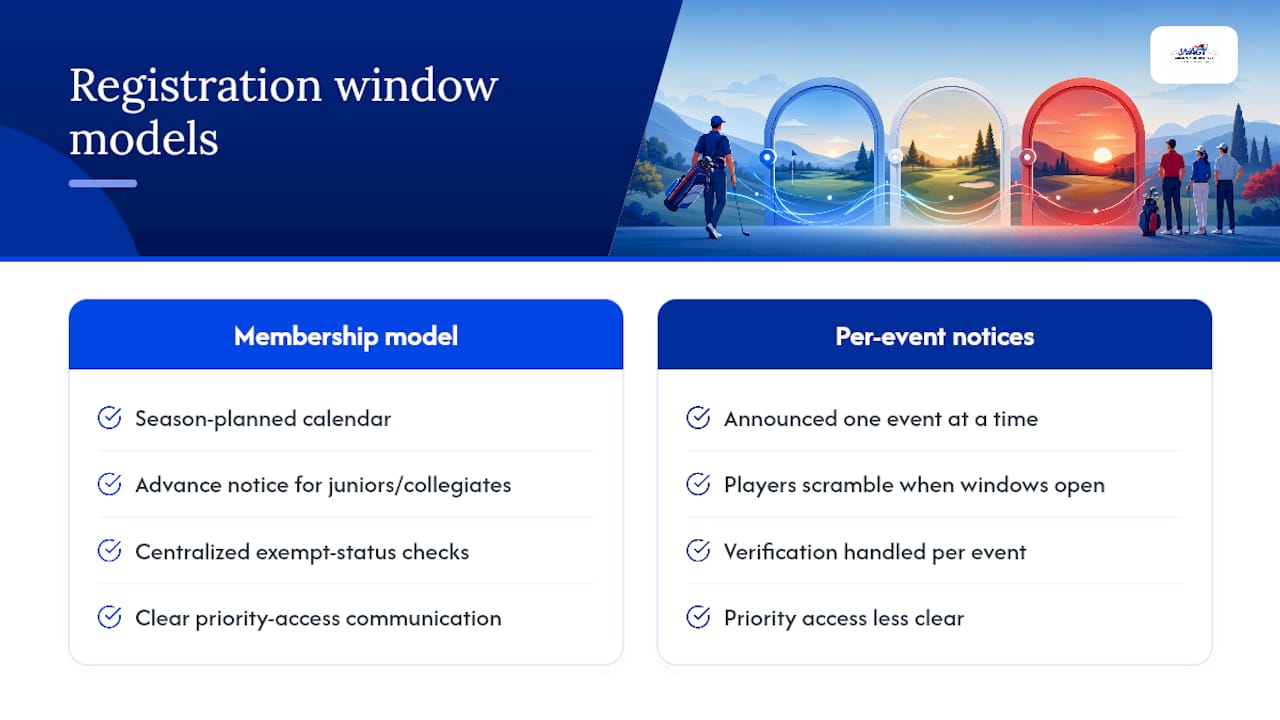
The organizer runs WAGR-counting events built around a membership model, with registration windows planned around the season schedule rather than announced one event at a time. That structure gives junior, collegiate, and amateur golfers advance notice of upcoming events instead of scrambling when a window suddenly opens.
Verifying exempt status, confirming eligibility, and communicating priority access clearly all matter more in WAGR-sanctioned events, since ranking points are on the line. A membership-based approach lets Worldamateurgolftour publish a consistent calendar and keep field integrity intact across every partner venue.
Balancing Open Access With Competitive Fairness
Tiered invites make sense for championships and WAGR-counting events, where field quality and rating integrity matter more than raw participation numbers. Community fundraisers should lean the other way, favoring open access because the goal is turnout and dollars raised, not competitive precision.
The trade-off is real: tiered systems cost more administrative time, while fully open registration risks a mismatched field. Pick one primary goal for your event, then build your windows, fees, and communication plan to serve that goal instead of trying to satisfy both at once.
— Gene
Ready to Register for a WAGR-Counting Event?
There is a membership path available into professionally run tournaments where the registration windows, exempt tiers, and waitlist rules are clear from day one, not buried in a PDF you find after you've already paid.

Every event on the schedule counts toward World Amateur Golf Ranking status, so the entry window you register in actually has stakes beyond just getting a tee time. If you're a player looking to compete or a club interested in hosting a sanctioned event, visit World Amateur Golf Tour to check upcoming registration dates and get your membership set up before the next window opens.
Sources
- 2026 PDGA Pro Worlds Disc Golf Championships Registration Schedule | Professional Disc Golf Association
- Carolinas Four-Ball Championship entry window and rule excerpt (PDF)
- Annual Golf Tournament - Virginia Beach Parks & Recreation
- Cvent event registration example (registration form guidance)
FAQ
What's the 70/30 Rule in Golf?
It's not a registration rule. It generally refers to the idea that roughly 70% of scoring outcomes come from short game and putting, while about 30% comes from full-swing shots, a rough guideline some coaches use to prioritize practice time rather than tournament administration.
How Do I Create a Golf Tournament Registration Form?
Start with essential fields only: name, contact info, handicap or rating, and payment, then follow up separately for detailed team logistics once the entry is confirmed. Testing the payment flow before your window opens prevents failed transactions when demand spikes.
Who Made $30 Million Without Ever Winning a Major Golf Tournament?
This refers to Colin Montgomerie, who built substantial career earnings across the European and PGA Tours despite never winning a major championship, relying instead on consistency across a long, successful career.
What Does "F" Mean in Golf?
"F" on a scorecard or leaderboard typically stands for "Final," indicating the player has completed their round, distinct from live in-progress hole markers.
When Does Golf Tournament Registration Typically Open?
It depends on event scale: club events often open 4 to 6 weeks before the tee time, while regional and championship events commonly open 3 to 6 months out, sometimes with an earlier exempt window for invited players.