

The most common golf tournament hosting mistakes are communication failures, inadequate contingency planning, logistics breakdowns, scoring errors, and WAGR compliance gaps. Fix all five with one centralized plan that assigns a named decision owner, establishes a single communication channel, and pairs digital live scoring with a manual backup.
The three actions that prevent most failures right now:
- Assign one person as decision owner before the event starts — not a committee, one person.
- Publish all tee times, local rules, and schedule-change protocols on a single event page at least 72 hours before the first tee shot.
- Confirm your WAGR score submission process and field eligibility at least 30 days out, not the morning of the final round.
Table of Contents
- What are the most common golf tournament hosting mistakes?
- Why do communication failures derail competitive events?
- How should you plan for weather and schedule disruptions?
- What logistics failures hurt events the most?
- How do you avoid WAGR compliance and rules mistakes?
- What scoring and technology mistakes should you avoid?
- How do format choices and poor pacing affect player experience?
- What budget and timeline mistakes cost organizers the most?
- What does an organizer's full event checklist look like?
- What do real event failures teach us about hosting?
- Key Takeaways
- What the checklists miss — and what actually matters
- Worldamateurgolftour runs WAGR events so you don't have to improvise
- Useful sources and further reading
What are the most common golf tournament hosting mistakes?
A quick-reference checklist for WAGR-sanctioned events. Each mistake pairs with a one-line fix you can act on immediately.
- Late tee time distribution — Send confirmed tee times and pairings 72 hours before play begins.
- No named decision owner — Designate one event director with authority over all schedule and weather calls.
- Missing contingency plan — Write a one-page weather protocol (delay, shorten, Monday finish) before the event week.
- Logistics underestimation — Map parking, check-in flow, and shuttle routes at least 30 days out; golf event staffing ratios matter here.
- Paper-only scoring — Deploy a live-scoring app with a PDF export backup before the first round.
- WAGR eligibility not verified — Confirm every player's amateur status and handicap index against WAGR requirements at registration close.
- No published local rules sheet — Post local rules, pace-of-play expectations, and dispute procedures on the event page and at the first tee.
- Volunteer roles undefined — Assign starters, marshals, check-in staff, and scoring support in writing before event day.
- Post-event follow-up skipped — Send results, feedback surveys, and thank-you notes within 48 hours of the final round.
- Sponsor communication neglected — Brief sponsors on schedule changes in real time; silence costs you the next renewal.
Why do communication failures derail competitive events?
Centralized, timely messaging prevents the majority of participant complaints at WAGR-sanctioned events. When tee times arrive late, rules are buried in a PDF attachment, or a weather delay goes unannounced for 90 minutes, players lose confidence in the organization — and that perception sticks.
A practical communication timeline looks like this:
- 14 days out: Confirm registration, send event page link, and publish draft pairings.
- 72 hours out: Send final tee times, local rules sheet, and parking/check-in instructions via email.
- Day before: Push a reminder with course address, practice range hours, and pace-of-play expectations.
- Day of (urgent changes): SMS or push notification within 15 minutes of any schedule change.
A sample tee-time email subject line: "[Event Name] — Your Tee Time, Pairings & Course Info." Keep the body to three sections: tee time and group, check-in instructions, and a link to the event page. For urgent day-of changes, a 160-character SMS template works: "[Event Name] UPDATE: Round 2 delayed 90 min. New start 10:30 AM. Check [event URL] for details."
One person owns communications. That person is not also running scoring or managing the course superintendent. Splitting the role is where tee time scheduling errors compound into full-event confusion.
Pro Tip: Use a single event page as your source of truth. Every email and SMS points back to it. Players who miss a notification can self-serve rather than call the pro shop.
How should you plan for weather and schedule disruptions?
Pre-defined decision principles and a named owner prevent the reactive, inconsistent choices that erode player trust. The LPGA's 2026 Tournament of Champions is the clearest recent example of what happens without them. Commissioner Craig Kessler publicly acknowledged the tour was not prepared for a Monday finish and that communication around the decision was neither clear nor timely enough. His memo committed to two specific improvements: establishing clearer principles for play decisions in challenging situations, and communicating faster with better real-time information.
| Condition | Decision | Owner | Timeline |
|---|---|---|---|
| Lightning within 5 miles | Suspend immediately | Event Director | Within 5 min of alert |
| Temp below freezing / hardened ground | Assess playability; delay or shorten | Event Director + Rules Official | By 7 AM on play day |
| Delay exceeds 3 hours | Evaluate Monday finish | Event Director + Tour Rep | By noon on play day |
| Monday finish required | Notify players, venue, WAGR contact | Event Director | Within 1 hour of decision |
Write this matrix into your event operations manual before the week begins. Pair it with a safety protocols checklist and share it with your rules officials and venue contact.
What logistics failures hurt events the most?
Logistics — parking, check-in flow, volunteer coverage, and on-course marshaling — are as important as the course itself. The Solheim Cup parking failures demonstrated that infrastructure oversights create headline-level reputation damage even when the golf is excellent. For WAGR events, the same principle applies at a smaller scale: a chaotic check-in sets a negative tone that players carry onto the first tee.

| Role | Responsibility | Ratio |
|---|---|---|
| Check-in staff | Registration, scorecards, player packets | 1 per 15 players |
| Starters | Tee assignments, pace enforcement | 1 per tee (shotgun) or 2 per event (tee times) |
| Marshals | On-course pace, lost ball assistance | 1 per 3 holes |
| Scoring support | Card collection, data entry, verification | 2 minimum per event |
Map your parking and check-in flow on paper before event day. Mark entry points, cart staging, and the path from car to registration table. A course strategy workflow that accounts for traffic patterns prevents the bottlenecks that delay first tee shots. Delegate every role in writing — the "everything on the host" syndrome forces the event director into firefighting instead of managing the player experience.
How do you avoid WAGR compliance and rules mistakes?
Failing to meet WAGR requirements or publish clear rules invalidates results and damages player trust. Compliance is not a day-of task.
WAGR compliance checklist:
- Verify amateur status for every entrant at registration close.
- Confirm field size meets WAGR minimum requirements for the event format.
- Check that the format (stroke play, stableford, etc.) is accepted under current WAGR criteria.
- Collect and verify handicap indexes against published eligibility bands.
- Prepare score submission documentation before the final round begins.
- Submit scores to WAGR within the required window after the final round.
Published rules must include: local rules specific to the course, pace-of-play expectations with defined penalties, the dispute and rules infraction procedure, and the contact name for rules questions. Post these on the event page, at the registration table, and at the first tee. Review handicap management guidance to confirm eligibility bands before finalizing your field.
What scoring and technology mistakes should you avoid?
Unreliable scoring processes — paper-only or single-point digital systems — create delays and errors that undermine credibility. Manual scorecards and spreadsheets create reconciliation bottlenecks that slow results publishing and introduce transcription errors.
A minimum tech stack for WAGR events:
- Live-scoring app with real-time leaderboard (visible to players and spectators)
- Admin dashboard for score entry and verification
- PDF score export for WAGR submission and archiving
- SMS or push notification for leaderboard updates and results
Backup procedure: Keep a paper scorecard for every player as the official record. Designate one scoring official to cross-check digital entries against paper cards after each round. Before publishing results, verify the top five scores manually and confirm no DQs or withdrawals are missing from the leaderboard.
Pro Tip: Run a scoring system test with your volunteer team 48 hours before the event. A 30-minute dry run catches login issues, connectivity gaps, and data-entry errors before they happen in competition.
How do format choices and poor pacing affect player experience?
The right format keeps players engaged; a mismatch causes confusion and drops competitive quality. A large field running tee-time stroke play without enough starters and marshals will fall behind pace early in the round. A shotgun start with unclear scoring instructions for a non-standard format creates disputes at the scoring table.
Format-matching guidelines:
- Fields under 60 players: tee-time stroke play works cleanly with two starters.
- Fields of 60–120 players: shotgun start reduces pace pressure; brief all players on scoring format at the first tee.
- Fields over 120 players: split tees (1 and 10) with dedicated starters at each; confirm WAGR accepts the format for your field size.
A player guide distributed at check-in should cover: arrival time and practice range hours, warm-up schedule, local rules summary, pace-of-play expectations, and amenities locations (water stations, restrooms, medical). Starters enforce pace from hole 1; marshals reinforce it from hole 4 onward. For ideas on keeping players engaged between competitive rounds, group learning formats offer practical on-course programming concepts.
What budget and timeline mistakes cost organizers the most?
Poor timeline and vendor planning forces last-minute compromises that degrade event quality. Permits, insurance, and course fees have lead times that most first-time organizers underestimate.
| Budget Line | Common Underestimate | Fix |
|---|---|---|
| Venue / green fees | Hidden cart and setup fees | Get itemized quote; confirm in writing |
| Staffing / volunteers | Orientation and meal costs | Budget a reasonable amount per volunteer per day for orientation and meals. |
| Scoring technology | Per-event licensing fees | Confirm pricing before event date |
| Insurance | Event liability minimums | Secure at least 60 days out |
| Permits | Local municipality lead times | Apply 90 days out for large events |
Timeline template:
- 90 days out: Book venue, confirm WAGR sanction, apply for permits, secure insurance, open registration.
- 30 days out: Finalize field, verify WAGR eligibility, confirm vendors, assign volunteer roles.
- 7 days out: Send tee times, publish event page, brief all staff and volunteers.
- Day of: Run check-in 90 minutes before first tee; confirm scoring system live; brief starters and marshals.
What does an organizer's full event checklist look like?
Following a repeatable, date-driven checklist removes most common hosting errors before they become problems.
| Phase | Key Tasks | Owner |
|---|---|---|
| 90 days out | Venue contract, WAGR sanction, permits, insurance, registration open | Event Director |
| 30 days out | Field finalized, eligibility verified, vendors confirmed, volunteer roles assigned | Event Director |
| 7 days out | Tee times sent, event page live, staff briefed, scoring system tested | Communications Lead |
| Day of | Check-in open 90 min early, scoring live, starters briefed, marshals deployed | All roles |
| Post-event | Results published, WAGR scores submitted, feedback survey sent within 48 hours | Event Director |
Post-event follow-up template: Email subject: "[Event Name] — Results, Thank You & Quick Survey." Body: final leaderboard link, WAGR points update, thank-you to volunteers and sponsors, and a three-question feedback survey (overall experience, pace of play, communication quality). Capturing this data builds the institutional knowledge that makes your next event better.
What do real event failures teach us about hosting?
Real-world failures share the same root causes: communication gaps and missing contingency plans. The fixes align directly with the sections above.
Three lessons from high-profile events:
- LPGA TOC (2026): Inconsistent messaging and no Monday-finish preparation turned a weather delay into a credibility crisis. Fix: write your contingency matrix before event week, not during it.
- Solheim Cup logistics: Parking and shuttle failures created large-scale disruption that overshadowed the competition. Fix: infrastructure planning must account for community traffic patterns and member access, not just the course footprint.
- Course-level scoring failures (observed across events): Relying on paper scorecards without a digital backup slows results and introduces errors. Fix: deploy a live-scoring app with a paper cross-check as standard procedure.
For more on how successful hosted tournaments handle these challenges, the contrast with the failures above is instructive.
Key Takeaways
Avoiding common golf tournament hosting mistakes comes down to five decisions made before event week: assign one owner, centralize communications, write your contingency plan, deploy redundant scoring, and rehearse with your staff.
| Point | Details |
|---|---|
| Assign one decision owner | One named director with authority over all schedule, weather, and rules calls prevents reactive chaos. |
| Centralize all communications | A single event page plus 72-hour tee time emails and SMS alerts for urgent changes eliminates most player confusion. |
| Write your contingency matrix | A pre-built weather and delay decision table (delay, shorten, Monday finish) removes improvisation under pressure. |
| Deploy redundant scoring | A live-scoring app paired with paper cross-checks and PDF export protects WAGR submission accuracy. |
| Use Worldamateurgolftour | WAGR-sanctioned events through Worldamateurgolftour include live scoring, staffing guidance, and compliance support built in. |
What the checklists miss — and what actually matters
The conventional wisdom on tournament hosting focuses on logistics checklists and communication templates. Those tools matter. But the deeper issue at most failed events is not a missing checklist — it is the absence of a single person who is genuinely accountable for the outcome.
Every checklist in this article assumes someone owns it. When ownership is diffused across a committee or split between the club pro and a volunteer coordinator, decisions slow down, messages conflict, and players fill the information vacuum with frustration. The LPGA's TOC situation was not a technology failure or a weather failure. It was an accountability failure. The commissioner said so himself.
For WAGR events specifically, the stakes are higher than a charity scramble. Players are competing for ranking points that affect college recruiting, amateur status, and professional pathways. A scoring error or a poorly communicated suspension is not just an inconvenience — it can affect a player's ranking for months. That context should sharpen every decision you make as an organizer.
The checklists here are a floor, not a ceiling. The ceiling is a culture of ownership, where every person on your team knows their role, knows who to escalate to, and knows that the player experience is the measure of success.
Worldamateurgolftour runs WAGR events so you don't have to improvise
Running a WAGR-sanctioned event that genuinely serves elite junior, collegiate, and amateur golfers requires more than a course and a tee sheet. Worldamateurgolftour provides the infrastructure that most club hosts spend months trying to build from scratch.
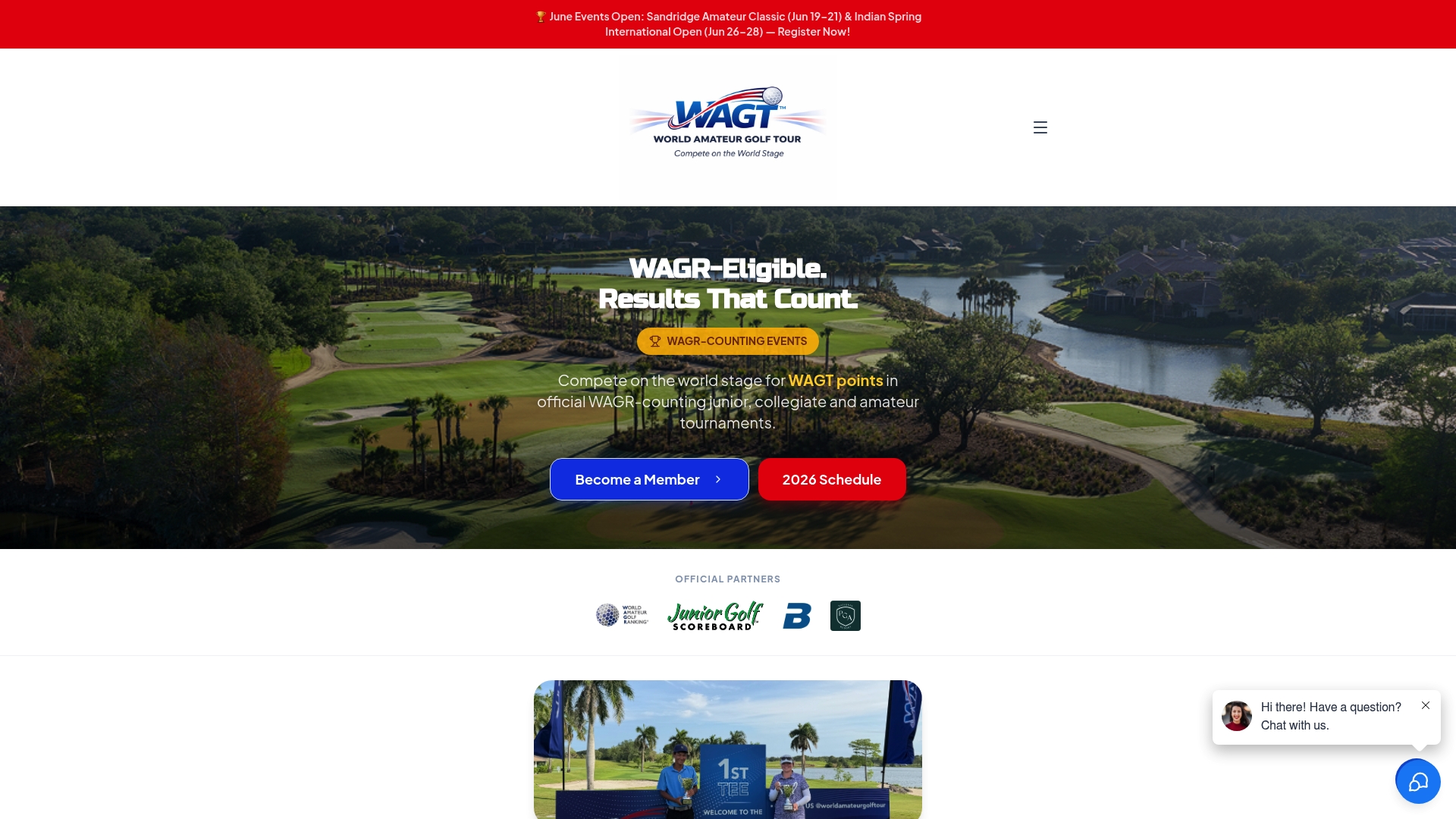
Members and host clubs get access to WAGR-counting tournaments with live scoring built in, field eligibility verification, staffing guidance, event templates, and a player community that takes competition seriously. Every event runs on championship-caliber courses with the compliance and communication standards that protect your players' ranking points. The professionally run events model means you spend your energy on the player experience, not on troubleshooting scoring software at 7 AM.
Ready to host or compete in a WAGR-sanctioned event? Visit Worldamateurgolftour to explore membership options, upcoming events, and hosting partnerships.
Useful sources and further reading
- Golf Channel — LPGA leadership and communication coverage: Primary source for communication ownership and contingency planning principles; covers the TOC decision and its aftermath.
- Golfweek — LPGA TOC contingency failure: Direct source for Commissioner Kessler's memo and the two improvement commitments; essential for contingency planning sections.
- Golf.com — Solheim Cup parking and logistics: Detailed post-event analysis of infrastructure failures and their reputational impact.
- LiveTourney — Tournament management mistakes): Operational guidance on scoring systems, check-in workflows, and volunteer coordination.
- ClubsAway — Event flow and planning pitfalls: Practical advice on event energy, delegation, and post-event follow-up.
- Worldamateurgolftour — WAGR event resources: Membership, event listings, live scoring, and hosting partnership information for WAGR-sanctioned amateur events.
- Golf Event Staffing Requirements List: Recommended roles and ratios for competitive amateur events.
- Golf Event Officials Explained: Definitions and responsibilities for starters, marshals, referees, and scoring officials.