

To host a WAGR-sanctioned golf tournament, your event must meet a defined set of compliance standards set jointly by The R&A and the USGA: a minimum field of 16 players for men's or mixed events and 8 for women-only events, a 54-hole stroke play format across at least three days, and strict adherence to the Rules of Golf, Rules of Amateur Status, and Equipment Rules. These are not suggestions. Miss any one of them and your event does not qualify for official World Amateur Golf Ranking (WAGR) points, no matter how well you run the rest of it.
Here is what that means in practice before you submit a single application:
- Field size: 16+ players for men's or mixed events; 8+ for women-only events
- Format: Stroke play, minimum 54 holes across three competitive rounds
- Rules adherence: Full compliance with R&A and USGA Rules of Golf, Amateur Status, and Equipment Rules
- Officiating: Certified referees on course throughout the event
- Documentation: Structured event format, complete player list, hole locations, tee marker setup, and referee reports
- Post-event submission: Scoring data, player results, and compliance evidence submitted to the WAGR committee promptly after the event
Get all of this right and your players earn official global ranking points. That is the draw for elite junior and amateur competitors, and it is what separates a WAGR-sanctioned event from every other amateur tournament on the calendar.
What are the core compliance criteria for WAGR-sanctioned events?
WAGR compliance goes deeper than field size and format. Every operational element of your tournament must meet a specific standard, and the 2026 guidelines reflect an increased emphasis on documentation accuracy and post-event reporting.

Field size and format requirements
The minimum field sizes are firm: 16 players for men's or mixed competitions, 8 for women-only events. Your format must be stroke play. Match play events, scrambles, and best-ball formats do not qualify. The event must span at least three days with 54 holes of competitive play, and a cut after round two is standard practice for events with larger fields.
Rules of Golf and Amateur Status
Every shot played must be governed by the current Rules of Golf as published by The R&A and the USGA. Beyond that, all competitors must hold valid amateur status under the Rules of Amateur Status, also jointly administered by The R&A and the USGA. Equipment used must comply with the Equipment Rules. These three rule sets work together, and your event documentation must confirm compliance with all three, not just one.
Course setup and officiating standards
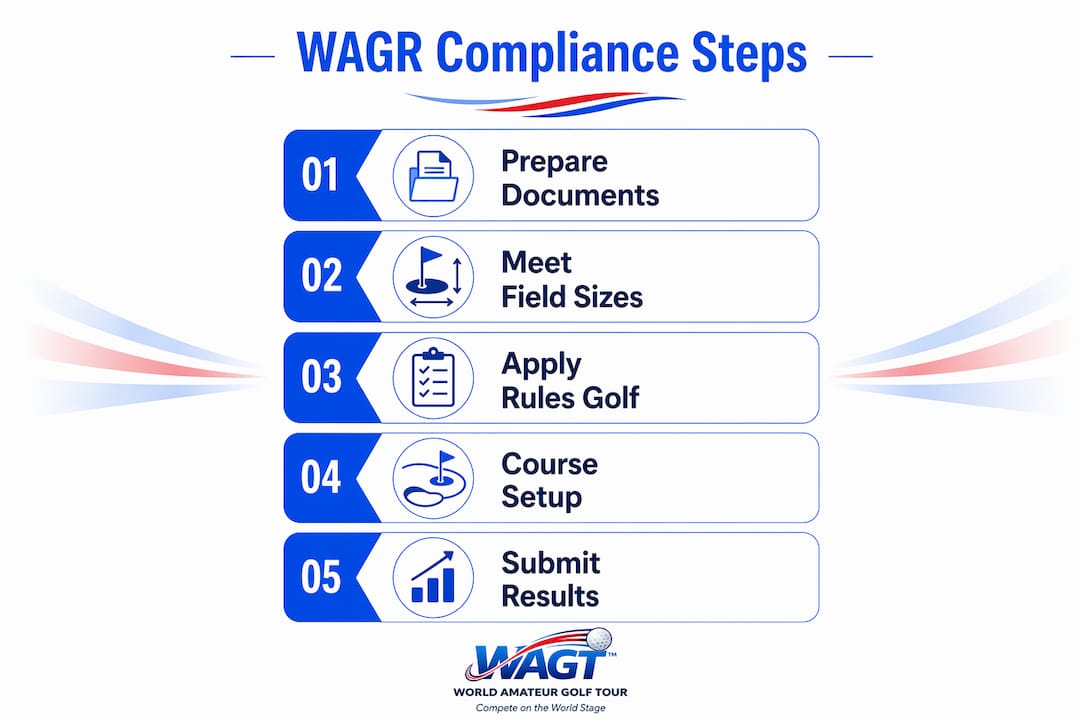
Your course setup must be documented before play begins. That means recorded hole locations, defined tee markers for each round, and a course rating that meets WAGR standards. Certified officials must be present throughout the event, not just available by phone. The quality of officiating directly affects your compliance record, and any unresolved rules incidents that go undocumented can jeopardize your post-event submission.
Post-event submission requirements
After the final round, you must submit a complete data package to the WAGR committee. This includes:
- Final scoring for every competitor
- Complete player list with handicap or ranking data
- Referee reports covering any rules incidents
- Compliance evidence confirming adherence to format, field, and rules requirements
- Course setup documentation for all three rounds
The table below summarizes the key compliance criteria and their specific thresholds.
| Compliance Area | Requirement |
|---|---|
| Men's/mixed field size | Minimum 16 players |
| Women-only field size | Minimum 8 players |
| Tournament format | Stroke play only |
| Minimum rounds | 54 holes across 3 days |
| Rules adherence | R&A and USGA Rules of Golf, Amateur Status, Equipment Rules |
| Officiating | Certified referees on course throughout |
| Post-event submission | Scores, player data, referee reports, compliance evidence |
How do you apply for and maintain WAGR sanctioning?
The sanctioning process is a formal review, not a rubber stamp. The WAGR committee evaluates your documentation against the published criteria before granting approval, and that approval must be renewed for each edition of your event. Here is how the process works from start to finish.

Preparing your application
Before you contact the WAGR committee, your documentation must be complete. Incomplete applications delay review and can push your approval past your event date. Prepare the following:
- Full event format description, including number of rounds, cut policy, and tiebreak procedures
- Proposed course setup plan with hole locations and tee markers for each round
- Anticipated player list or field composition, including how players qualify
- Evidence of certified officiating arrangements
- Confirmation of Rules of Golf, Amateur Status, and Equipment Rules compliance
The submission and review process
- Submit your application to the WAGR committee with all documentation at least three to four months before your event date. Earlier is better.
- Await initial review. The committee checks your submission against current WAGR criteria and may request clarification or additional documentation.
- Respond to feedback promptly. If the committee flags a gap, address it immediately. Delays in responding can push your approval timeline past the point of usefulness.
- Receive conditional or full approval. Some events receive conditional approval pending final field confirmation or course setup verification.
- Confirm final field and setup. Once your field is locked and your course setup is finalized, submit confirmation to the committee.
- Run the event under full compliance. Every round must be officiated and documented as agreed in your application.
- Submit post-event data. Within the required window after your final round, submit all scoring, player data, and compliance documentation.
- Maintain records for future editions. Your compliance history supports faster approval in subsequent years.
Sustaining sanctioning year over year
WAGR sanctioning is not a one-time credential. Each edition of your event requires its own application and approval. Your compliance record from prior years matters: events with clean submission histories tend to move through review faster. If WAGR criteria evolve, and the 2026 updates reflect that they do, your event format must evolve with them. Assign one person on your committee as the WAGR compliance lead, someone who tracks regulatory updates from The R&A and the USGA and keeps your documentation current.
Pro Tip: Build a compliance folder for each event year that contains every required document before you submit your application. When the committee requests something, you send it the same day. That single habit shortens your approval timeline more than anything else.
How does WAGR compliance affect ranking points for players?
WAGR ranking points are not distributed equally across all sanctioned events. The number of points available at your tournament depends directly on how well your event meets WAGR criteria, the strength of your field, and the accuracy of your post-event data submission.
The compliance and field strength connection
An event that meets the minimum field size of 16 men's players and runs 54 holes of stroke play earns a baseline point allocation. But the points available to top finishers scale upward with field strength. A field of 60 ranked junior players competing at a championship-caliber course generates a meaningfully different points distribution than a field of 17 players at the minimum threshold. The WAGR algorithm accounts for the competitive quality of the field, not just its size.
- Format compliance: Stroke play across 54 holes is the qualifying baseline. Fewer rounds or non-qualifying formats produce zero points.
- Field size: Larger, stronger fields increase the points available to top finishers.
- Player ranking data: The strength of the field is calculated using players' existing WAGR rankings. Accurate player data at submission directly affects this calculation.
- Officiating quality: Unresolved rules incidents or incomplete referee reports can trigger a review that delays or reduces point validation.
- Data submission accuracy: Errors in final scoring or player identification can invalidate points for affected competitors.
What this means for your event strategy
If your goal is to attract elite junior players, you need to offer meaningful points. That means building a field that goes well beyond the minimum, running a clean three-round competition, and submitting accurate data fast. Players and their coaches track WAGR events closely. An event with a strong compliance record and a history of clean point allocations builds a reputation that draws better fields year after year.
Pro Tip: Assign a dedicated scoring and data lead whose only job on event day is accuracy. One transposed score or misidentified player can delay point allocation for your entire field. A second set of eyes on every scorecard before submission costs nothing and protects your event's reputation.
What challenges do organizers face in maintaining WAGR compliance?
Meeting WAGR standards once is achievable. Sustaining them across multiple editions, while managing the real-world logistics of a multi-day amateur tournament, is where most organizers run into trouble. The most common compliance issues fall into three categories: field management, documentation, and officiating.
Field size and scheduling challenges
Maintaining a field of 16 or more competitive players across three full days of stroke play is harder than it sounds. Withdrawals happen. Travel conflicts, injury, and weather all affect participation. If your field drops below the minimum threshold before the event concludes, your WAGR status for that edition is at risk. Build your field to a buffer above the minimum, and have a clear withdrawal policy that accounts for WAGR requirements.
Multi-day scheduling creates its own pressure. Securing a championship-caliber course for three consecutive days, coordinating tee times across a full field, and managing pace of play across 54 holes all require detailed logistics planning that goes well beyond a single-day event.
Documentation and data submission difficulties
- Incomplete hole location records from one round can invalidate your course setup documentation.
- Player eligibility issues, such as a competitor whose amateur status is under review, must be resolved before the event or documented carefully.
- Post-event data submission windows are firm. Missing the deadline, even by a day, can delay point allocation for your entire field.
- Referee reports must cover every rules incident, not just the ones that affected the outcome.
Officiating and course setup standards
Certified officiating is a non-negotiable requirement, but finding qualified referees for a three-day amateur event takes advance planning. Many clubs underestimate the lead time needed to secure certified officials, particularly for events scheduled during peak season. Your course setup, including tee markers and hole locations, must be documented before each round begins, not reconstructed afterward.
Pro Tip: Use a WAGR compliance checklist that mirrors the official criteria point by point. Walk through it with your tournament director three weeks before the event, then again the day before play begins. Catching a documentation gap at week three gives you time to fix it. Catching it the morning of round one does not.
Why does hosting a WAGR-sanctioned event benefit your club and players?
The benefits of WAGR sanctioning extend well beyond the ranking points themselves. Hosting WAGR-status events positions your club as a serious competitive venue and draws a caliber of player, parent, and coach that most amateur events never see.
Elevated club profile and visibility
A WAGR-sanctioned event signals to the broader golf community that your course meets championship standards and your organization runs a clean, well-officiated competition. Elite junior players and their families research WAGR events specifically when planning their competitive calendars. Hosting one puts your club in front of that audience directly, bringing influential coaches, college recruiters, and junior golf families to your facility.
A genuine pathway for players
For junior and collegiate players, WAGR points are a concrete currency. College golf programs track WAGR rankings when evaluating recruits. A strong finish at a sanctioned event can move a player's ranking in ways that open doors to collegiate exposure and, for the most competitive players, a pathway toward professional golf. Your event becomes part of that story.
- Elite talent recruitment: WAGR status draws players who are serious about their ranking, not just their score.
- College exposure: Top finishers gain visibility with college programs that monitor WAGR rankings actively.
- Professional pathway: For the most competitive amateurs, WAGR points contribute to the ranking profile that supports a transition to professional play.
- Community building: WAGR events attract coaches, parents, and junior golf organizations, creating a community around your club's competitive program.
The competitive draw of official ranking points
Players choose their tournament schedule based on where they can earn the most meaningful points. An event with WAGR status automatically ranks higher on that list than an unsanctioned event with a larger prize or a more famous venue. The ranking points are the draw, and your compliance is what makes them available.
Hosting a WAGR-sanctioned event allows clubs to showcase their facilities, attract influential juniors, parents, and coaches, and increase regional interest in their competitive offerings.
How do you plan a WAGR-compliant tournament from start to finish?
Planning a WAGR-compliant event requires a longer runway than most organizers expect. Large-scale amateur golf tournaments should begin planning 6–9 months in advance, with a budget that includes at least a 10% contingency for unforeseen costs. That timeline is not generous for a WAGR event. It is the minimum.
Build your committee and assign clear roles
Your planning committee needs defined ownership, not shared responsibility. Assign one person to each of these roles before any other planning begins:
- Tournament Director: owns the overall event, manages the timeline, and makes final calls on compliance decisions
- WAGR Compliance Lead: tracks regulatory updates, manages documentation, and owns the application and post-event submission
- Operations Manager: handles course coordination, tee times, and day-of logistics
- Scoring and Technology Lead: manages scoring systems, live leaderboards, and data accuracy
- Sponsorship and Marketing Coordinator: drives field recruitment, sponsor relationships, and event promotion
Select your format and field strategy
Your format is fixed by WAGR criteria: stroke play, 54 holes, three days. Your field strategy is where you have room to build. Target a field well above the 16-player minimum for men's events strengthens your point allocation and makes your event more attractive to the next wave of recruits.
Use technology to manage scoring and player experience
Real-time scoring apps and live leaderboards enhance both player experience and operational accuracy at WAGR tournaments. Players and coaches follow the leaderboard throughout the round, which raises the competitive energy of the event. Digital scoring also reduces the risk of transcription errors in your post-event data submission, protecting your compliance record.
Pro Tip: A player-first experience from registration through the awards ceremony drives repeat participation. The ranking points bring players to your event the first time. The experience is what brings them back, and repeat fields are what build your event's reputation over time.
Sample planning timeline
- 9 months out: Define event format, select course, begin WAGR application preparation
- 7–8 months out: Assemble planning committee, assign roles, open field recruitment
- 6 months out: Submit WAGR application with full documentation
- 4–5 months out: Confirm officiating team, finalize course setup plan
- 3 months out: Confirm field composition, respond to any WAGR committee feedback
- 6–8 weeks out: Finalize tee times, publish event schedule, confirm technology platforms
- 2–3 weeks out: Run compliance checklist, confirm all documentation is complete
- Event week: Execute course setup, conduct player briefing, run certified officiating throughout
- Within 1 week post-event: Submit all scoring data, player results, and compliance documentation to WAGR
Pair this timeline with a solid amateur golf season planning strategy and you will avoid the last-minute scrambles that derail otherwise well-run events. Also consider reviewing a golf accessories checklist to help players and organizers prepare for the full competitive experience on event day.
What do successful WAGR-sanctioned events in the US look like?
Two events illustrate what WAGR compliance looks like in practice and what organizers can learn from them.
The FCG Western States Junior Players Cup
The FCG Western States Junior Players Cup is one of the most recognized WAGR-ranked junior events in the country. Now in its 18th edition, the 2026 event runs February 14–16 at Menifee Lakes Country Club in Menifee, California, a course with the layout and conditioning to support three full rounds of competitive stroke play. The format is exactly what WAGR requires: 54 holes, boys and girls divisions, with a cut after day two for top performers.
What makes this event a useful model is the combination of compliance and competitive draw. Players earn WAGR points and AJGA performance stars, which are a key metric in college golf recruiting. The 2026 edition also introduces the Three Nations Cup, an international team competition featuring elite junior players from the United States, Canada, and Mexico running concurrently with the main event. That kind of layered programming, built on top of a clean WAGR-compliant foundation, is what turns a sanctioned event into a destination.
The lesson for organizers: WAGR compliance is the floor, not the ceiling. Once your event meets the technical criteria, the programming decisions you make on top of that foundation determine whether elite players put it on their calendar.
The Arkansas Junior Amateur Championship
The Arkansas State Golf Association's decision to move the Arkansas Junior Amateur Championship to a 54-hole format at Hardscrabble Country Club in Fort Smith is a clear example of a state-level organization deliberately building toward WAGR status. The event, scheduled for June 30 to July 2, targets a field of approximately 60–90 boys and 30 girls, well above the minimum thresholds.
"This marks a major step forward for junior golf in Arkansas," said Tyler Meyl, ASGA's director of member services and junior golf. "We made this change to have the event WAGR ranked and look to receive an exemption for the U.S. Junior Amateur Championships."
Hardscrabble itself has hosted 13 PGA tournaments and served as an official LPGA Tour stop from 1948 to 1950, giving the event a venue with genuine competitive credentials. The ASGA's approach, selecting a course with a proven championship history and building the format around WAGR requirements from the start, reflects exactly the kind of deliberate planning that produces clean applications and fast approvals.
The lesson here is about venue selection and format commitment. Choosing a course that can credibly host a championship-level event, and committing to the 54-hole format before you apply, signals to the WAGR committee that your organization is serious. That credibility carries weight in the review process.
Ready to run your own WAGR-sanctioned event?
Worldamateurgolftour runs professionally managed WAGR-counting tournaments that give junior, collegiate, and amateur players a direct pathway to global ranking recognition, collegiate exposure, and elite competition. Every event is built on the compliance standards covered in this guide, with experienced tournament directors, certified officiating, and a player-first experience from registration through the awards ceremony.
If you are ready to compete or partner with an organization that has already done the compliance work, visit Worldamateurgolftour and explore the 2026 event schedule. Your players deserve events that count.
Key Takeaways
Hosting a WAGR-sanctioned golf tournament requires meeting specific field, format, and documentation standards set by The R&A and USGA, submitting a formal application, and maintaining compliance across every edition of your event.
| Point | Details |
|---|---|
| Minimum field requirements | Men's/mixed events need 16+ players; women-only events need 8+ players. |
| Format is fixed | Stroke play across 54 holes and three days is the only qualifying format. |
| Plan 6–9 months out | Start your application and logistics planning at least 6–9 months before your event date. |
| Points scale with compliance | Field strength, format adherence, and data accuracy all affect how many WAGR points your event distributes. |
| Sanctioning renews annually | Each edition requires its own application; a clean compliance history speeds up future approvals. |