

Tournament rewards programs are membership benefits that convert your participation in WAGR-counting events into gear vouchers, entry credits, and player-development tools. Done right, they cut your net cost of competing and give recruiters more reasons to notice you. The smartest move is joining a membership built around WAGR-counting events with published event Power and clear redemption rules, not one that treats rewards as a marketing gimmick bolted onto low-quality tournaments.
TL;DR:
- Playing in high-power WAGR-counting events yields significantly more ranking points, even with a single top finish, than multiple low-power tournament starts.
- Rewards programs often include expiration windows, blackout dates, and require matching registration names to ensure credits and results are valid and useful.
- Prioritizing entry credits for the highest-power tournaments with published event Power maximizes ranking gains over simply accumulating volume or gear vouchers.
- Hidden costs such as travel, lodging, transfer fees, and restrictions can erode the real value of rewards if not carefully checked beforehand.
- Consistent, strategic participation in selected high-power events within a two-year result window optimizes ranking growth and recruitment exposure.
Table of Contents
- What Tournament Rewards Programs for WAGR-Counting Events Typically Include
- How WAGR Counting and Event Power Determine Ranking Points
- How to Evaluate and Compare Tournament Rewards Programs
- How to Use Rewards Strategically to Boost WAGR and Recruitment Chances
- Eligibility and Timeline: Who Qualifies and How Long Results Count
- Comparing Tournament Rewards Program Tiers
- Hidden Costs Beyond Entry Fees and Gear Credits
- A Season-Long Timeline for Earning and Redeeming Rewards
- Common Pitfalls and Red Flags to Watch For
- Why Rewards Programs Matter for Junior Development
- Join a Membership Built Around WAGR-Counting Events
- Official WAGR Guidance and Explainers to Read Next
- Sources
- FAQ
What Tournament Rewards Programs for WAGR-Counting Events Typically Include
Most programs split benefits into two buckets: annual membership perks and per-event rewards. Membership perks are the standing benefits you get just for being enrolled, things like access to a full season of WAGR-counting events, player profile tools, and a baseline entry-credit allotment. Per-event rewards are earned through play, tied to specific outcomes like a top finish, a first-time start, or bringing in another family through referral.
The mechanics vary by provider, but the common reward types look like this:
- Gear vouchers redeemable for apparel, equipment, or branded merchandise
- Entry credits applied toward future tournament registration fees
- Referral rewards for bringing new players into the membership
- Recruiting exposure through searchable player profiles that coaches can access
- Resume features that compile scores, finishes, and WAGR history in one place
Rewards typically trigger off participation counts, finishing position, or referral activity. Read the fine print, though. Credits often carry expiration windows, and some programs block redemption during peak-season "blackout" dates when demand for tournament slots is highest.
How WAGR Counting and Event Power Determine Ranking Points
Every ranking point you earn depends on something called event "Power." Not every WAGR-counting tournament is worth the same amount, and that single fact should shape how you spend your entry credits.
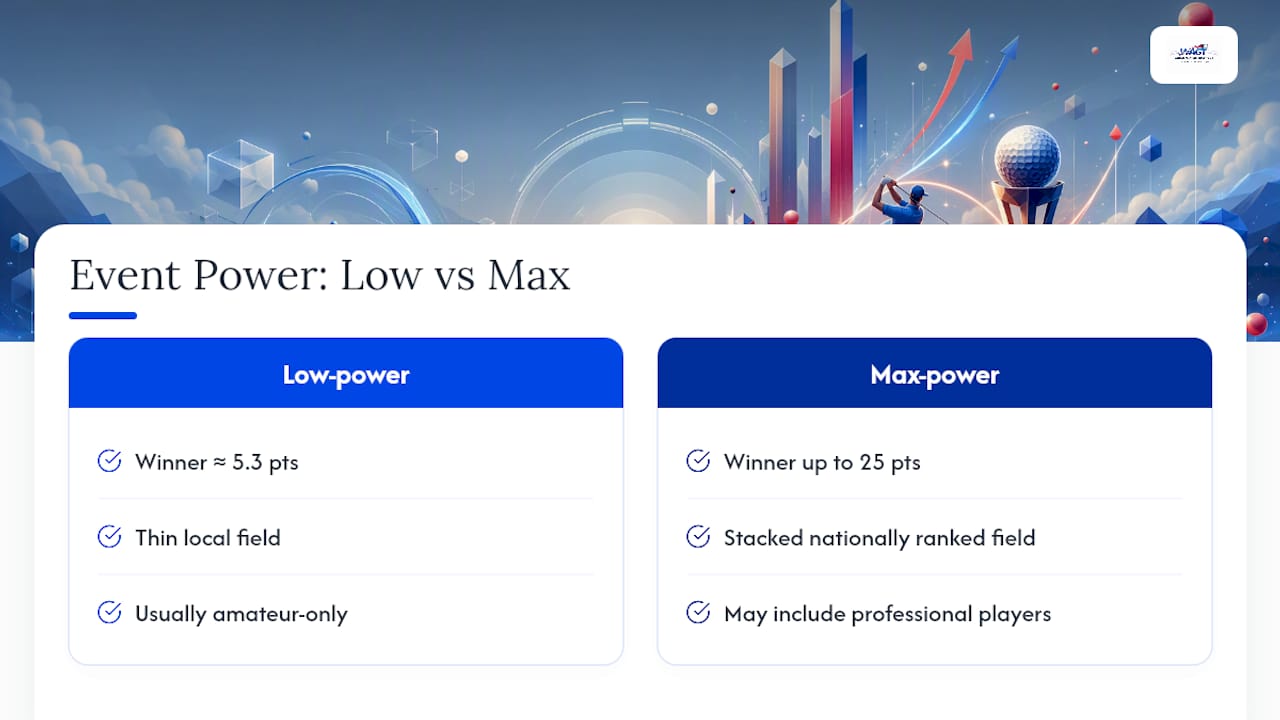
Power is a weighted measure of the field you're competing against, driven mainly by the strength and size of the players entered. A tournament stacked with nationally ranked competitors carries far more Power than a thin local field, even if both events count toward WAGR.
According to WAGR's official FAQ, winners of low-power events earn around 5.3 ranking points, while winners of maximum-power amateur events can earn up to 25 points.
That is nearly a five-fold difference for the same result: a win. Explainers on WAGR mechanics confirm that Power reflects both field strength and field size, and events that include professional competitors can post Power figures well above amateur-only fields.
There's a time dimension too. WAGR applies a weighting divisor that holds steady for the first 52 weeks after an event, then gradually increases until the result drops off entirely after 104 weeks. That means a strong finish at a high-power event six months ago still carries real weight in your current ranking, while a mediocre result at a low-power event from a year and a half ago is fading fast.
The practical takeaway: one appearance at a high-power event can outweigh several starts at low-power ones. This is why strength of field matters as much as your finishing position.
How to Evaluate and Compare Tournament Rewards Programs
Before you commit membership dollars to any rewards program, run it through this checklist:
- Confirm WAGR-counting status and typical Power. A program that advertises "ranking events" without publishing event Power figures is giving you half the picture. Look for tournaments detailed in guides like this breakdown of top WAGR-counting events.
- Calculate real redemption value. An entry credit is only worth its face value if you can actually use it before it expires and outside blackout windows. Factor in transfer and cancellation fees too.
- Assess development features. Live scoring, a searchable player profile, and recruiter access add value beyond the rewards themselves.
- Check transparency. Reputable programs publish event Power, refund and transfer policies, and a clear process for correcting scoring or name errors.
- Total the real cost. Add membership fees, travel, and entries, then weigh that number against the credits and exposure you'll realistically capture.
Pro Tip: Don't judge a rewards program by the size of the gear voucher. A $50 credit at a high-power, WAGR-counting event is worth more to your ranking than a $150 credit at a field with weak depth.
Industry commentary consistently backs this prioritization. Analysis on how WAGR rankings work points out that the weighted-average system rewards field quality over sheer tournament volume, which should guide where you spend rewards, not just whether you have them.
How to Use Rewards Strategically to Boost WAGR and Recruitment Chances
Rewards work best as a lever, not a discount. Here's how to use that lever across a season:
- Prioritize higher-power events with your credits. Save entry credits for the events with the strongest fields rather than spreading them thin across easier tournaments.
- Replace low-value results, don't just add to them. Since WAGR uses a rolling weighted average, a new high-power result can push out an older, weaker one from your profile. Guides on selecting events that actually move your ranking walk through this in more detail.
- Keep your registration name consistent. Small formatting differences between events can cause results to miss your official WAGR profile entirely.
- Push results to recruiters immediately after strong finishes. Use your player profile and resume tools to share scorecards and updated points while the performance is fresh.
- Use referral credits to offset costs, not to chase quantity. Bringing a teammate or sibling into the membership can generate extra credits, but the goal is still fewer, better starts.
This is where membership routes into WAGR-counting tournaments earn their value: they simplify the scheduling decisions so you can focus energy on performance instead of logistics.
Eligibility and Timeline: Who Qualifies and How Long Results Count
Eligibility for most WAGR-counting tournament memberships is straightforward: junior, collegiate, and amateur golfers who register with accurate personal information and meet the event's age or handicap requirements can typically enter. Some programs set a minimum number of events per season for a player to remain fully active in rewards tracking, similar to regional model rules like the Carolinas junior rankings program, which requires consistent name formatting and a baseline number of starts before results count reliably.
Once you compete, your result doesn't just post and sit still. WAGR applies that divisor weighting mentioned earlier: full weight for the first 52 weeks, a gradually declining weight after that, and a hard drop from your ranking profile at the 104 week mark. That two-year window is your effective ranking horizon.
Practically, that means a single great season can carry you for up to two years, but it also means complacency has a shelf life. A junior who wins a strong event as a sophomore and then goes quiet will watch that result fade out just as recruiting conversations with college coaches heat up. Understanding age division and eligibility checklists early in the season helps you plan which events actually count toward your active window, rather than discovering the timeline gaps after the fact.
Comparing Tournament Rewards Program Tiers
Most tournament rewards structures fall into three rough tiers, and each comes with tradeoffs worth understanding before you commit.
Entry-level tiers usually bundle a handful of WAGR-counting events with modest entry credits and no dedicated recruiting tools. The benefit is a lower up-front cost. The limitation is that you're often left to build your own schedule of high-power events, and gear rewards tend to be minimal.
Mid-tier memberships typically add player profile tools, live scoring access, and larger entry-credit pools redeemable across a season's worth of events. This tier tends to deliver the strongest value-per-dollar for serious juniors, since it pairs real WAGR exposure with usable rewards rather than just discounts.
Premium or "full season" tiers generally include the broadest event access, the most generous gear and credit allowances, and dedicated recruiter-facing resume features. The tradeoff is cost, and the value only pays off if you're actually playing enough high-power events to use the credits before they expire.
The mistake most families make is judging tiers by the dollar value of the rewards rather than by how well the included events match a player's actual ranking goals. A premium tier stacked with low-power events is still a weak investment, no matter how large the gear voucher looks on paper.
Hidden Costs Beyond Entry Fees and Gear Credits
Entry fees and advertised rewards rarely tell the whole financial story. Travel costs to reach higher-power events, often held at fewer, more competitive venues, can dwarf the entry fee itself once you factor in lodging and transportation for multi-day 54-hole formats.
Some programs also charge separate fees for late registration, score corrections, or transferring an entry to a different date, and those charges can quietly erode the value of an entry credit you thought was fully covering your cost. Membership renewal fees sometimes increase year over year without much notice, so it pays to check the current renewal terms rather than assume the price you paid last season still applies.
Gear vouchers can carry hidden strings too: minimum purchase thresholds, limited size or product availability, or shipping charges not covered by the credit's face value. None of these costs are dishonest by themselves, but they add up fast if you don't check for them before enrolling. Ask any program directly what its full fee schedule looks like, including anything beyond the headline entry and gear numbers, before you commit a season's budget to it.
A Season-Long Timeline for Earning and Redeeming Rewards
Rewards don't arrive all at once, and treating them as a season-long cycle helps you plan smarter.
Preseason (before your first event): Confirm your membership status, review published event Power for the season's tournament calendar, and set your registration name format so it stays consistent across every event.
Early season: Use your baseline entry credits on one or two mid-power events to build ranking momentum and confirm your results are posting correctly to your WAGR profile.
Midseason: This is when higher-power events cluster, and it's the point to spend your strongest entry credits. Strong midseason results carry the most weight going into recruiting season, since coaches are actively reviewing rankings during this stretch.
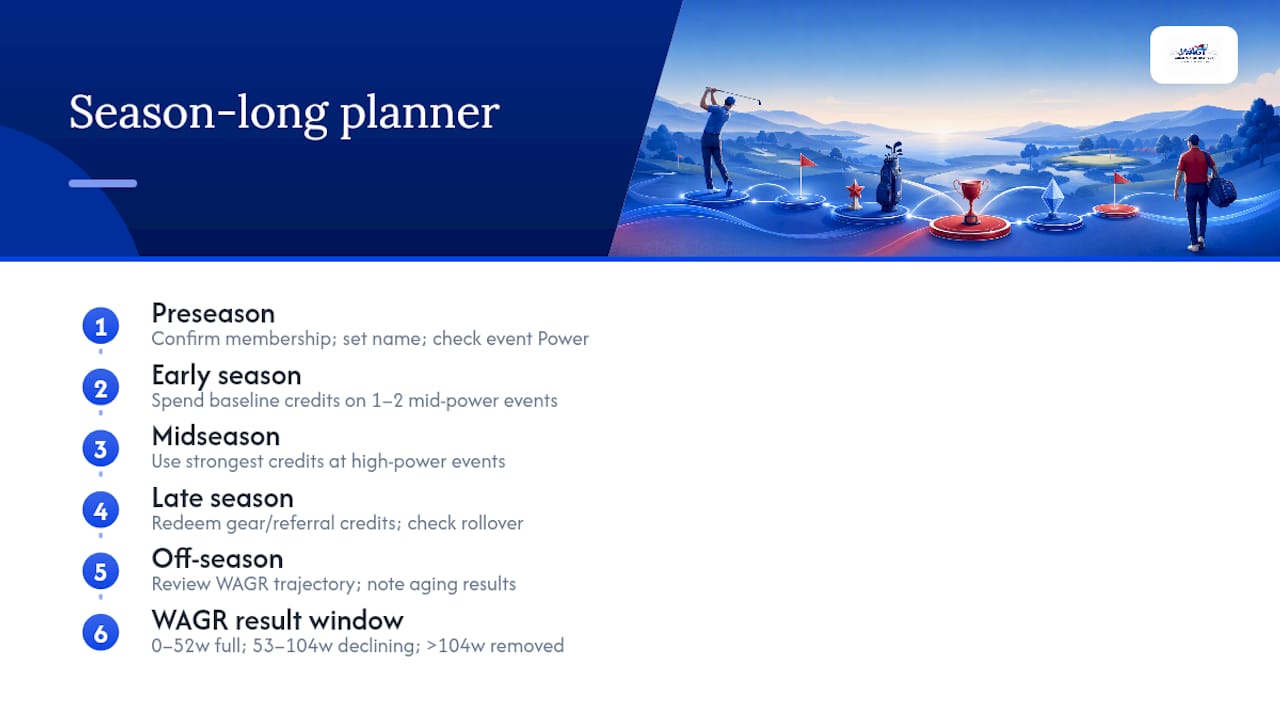
Late season: Redeem remaining gear vouchers before expiration, and check whether unused entry credits roll over or reset at renewal. Use any referral credits earned throughout the year here, since they're often the last reward type to expire.
Off-season: Review your full-season WAGR trajectory, note which results are approaching the 104-week drop-off, and start planning which events to prioritize the following year to replace aging results.
Common Pitfalls and Red Flags to Watch For
The biggest red flag in any tournament rewards program is a lack of transparency around event Power. If a provider can't tell you how their events rank in field strength, you have no way to judge whether your entry credits are being spent well.
Watch for programs that advertise large reward values but bury expiration dates or blackout periods in fine print you only discover after enrolling. A credit you can't realistically use before it expires isn't really a benefit. Name-formatting errors are another quiet trap. As Carolinas Golf's own junior rankings guidance points out, mismatched names between registration and official results can keep a strong finish from ever applying to your ranking profile.
Be wary of programs that push volume over quality, encouraging you to enter every available event rather than the handful that would actually move your weighted average. And always confirm a program's refund and transfer policy before a season starts. Injuries and schedule conflicts happen, and a rigid no-transfer policy can turn a paid entry into a sunk cost with zero reward value recovered.
Why Rewards Programs Matter for Junior Development
Rewards only matter if they point players toward better competition, not just cheaper competition. I've seen the pattern play out clearly: a junior uses saved entry credits to jump into one higher-power event instead of three low-power ones, posts a strong finish, and suddenly a college coach who'd never seen the player's name is checking their WAGR profile.
That's the real function of a well-run rewards program. It removes some of the cost friction that keeps talented juniors stuck playing easy fields, and it pairs that access with the profile and scoring tools that make results visible to the people who matter. Rewards don't replace coaching or smart scheduling. They just remove one more excuse for not playing the events that actually count.
— Gene
Join a Membership Built Around WAGR-Counting Events
Worldamateurgolftour's 2026 Annual Membership gives you what the checklist above demands: WAGR-counting tournaments with published event quality, professional event management, and entry-credit and gear-reward opportunities tied directly to your season of play, not disconnected from it.
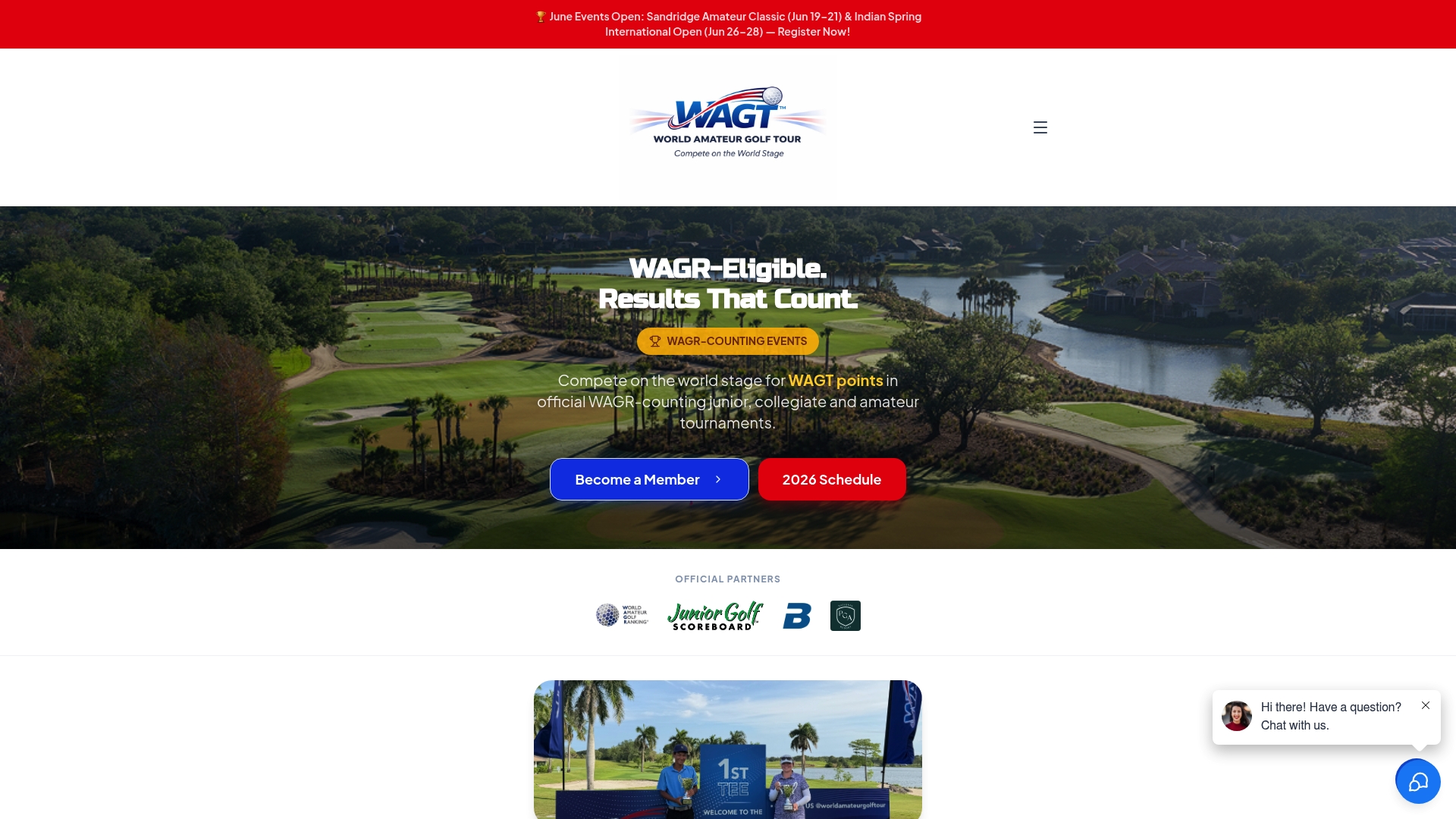
Membership can include access to events and series run at championship-caliber venues, ensuring entry credits are spent on ranked fields. Player profile tools often track results and WAGR points in one place, which can help golfers present their best scorecards to college coaches at key times. Every event on the calendar is built for players who want their entries and rewards working toward a real ranking outcome, not just a discount. Visit Worldamateurgolftour to check the current event schedule and get your membership started.
Official WAGR Guidance and Explainers to Read Next
For the technical details behind everything covered here, go straight to the source:
FAQ
What Counts as a Tournament Rewards Program?
It's a membership benefit structure that converts your participation in WAGR-counting events into gear vouchers, entry credits, or player-development tools like profile and recruiting features. The best programs tie those rewards directly to events with published, verifiable event Power.
How Many Ranking Points Can a Junior Golfer Earn?
Points depend on event Power and finishing position. Winners of low-power events earn around 5.3 points, while winners of maximum-power amateur events can earn up to 25 points, so event selection matters more than sheer participation count.
Does Worldamateurgolftour Have a Published Membership Price?
Current pricing for the 2026 Annual Membership is available directly on the Worldamateurgolftour website, since it varies by event schedule and package selected.
How Long Do Tournament Results Count Toward WAGR?
Results carry full weight for 52 weeks, then a gradually declining weight until they drop off entirely at 104 weeks. That two-year window is why consistent, high-power play matters more than a single strong season.
What Should I Check Before Redeeming an Entry Credit?
Confirm the target event is WAGR-counting, check its published event Power, and verify the credit hasn't hit an expiration date or blackout window. A credit is only valuable if you can actually use it on an event that improves your ranking.