

A golf event rain delay policy is the tournament committee's written framework describing who can suspend, shorten, or cancel play, how players must respond on course, how refunds or credits are handled, and how results affect World Amateur Golf Ranking (WAGR) points. For junior, collegiate, and amateur golfers competing in WAGR-counting events, understanding this policy before you tee off is as important as knowing your yardages.
Three outcomes are possible when weather disrupts your event:
- Suspension and resumption: The Tournament Committee halts play; you mark your ball, leave the course safely, and return when signaled.
- Shortened official result: The event is reduced (commonly to 18 holes for a multi-day contest) and scores stand; WAGR points may still be allocated if minimum play requirements are met.
- Cancellation with refund or credit: Play cannot continue; a tiered refund or event credit is issued based on how close to the start date you are.
WAGR point allocation depends entirely on whether the event completed the minimum required play for an official result and whether the event's WAGR-compliance notice confirms that points will be awarded.
Key Takeaways
A golf event rain delay policy gives the Tournament Committee authority to suspend, shorten, or cancel play under Rule 5.7b, with WAGR points, refunds, and player safety all determined by how that decision is documented and communicated.
| Point | Details |
|---|---|
| Committee authority | The Tournament Committee decides all weather outcomes under USGA Rule 5.7b, not the course or individual players. |
| On-course safety | Stop play immediately at the suspension signal, mark your ball, and evacuate; you may stop independently if lightning is imminent. |
| Refund tiers | Withdrawing before registration close typically yields a near-full refund; inside 48 hours, most organizers issue no refund. |
| WAGR point allocation | Points require the event to meet WAGR criteria and minimum play; check the published compliance notice and use official appeals if points are missing. |
| Worldamateurgolftour | Publishes weather policies, refund tiers, and WAGR-compliance notices for every event so players and families have full clarity before they register. |
Table of Contents
- What triggers a suspension or cancellation in a golf event?
- What players must do on course during a suspension
- How committees decide to resume, shorten, or cancel your event
- How refunds, credits, and waitlists work when events are disrupted
- How rain delays and cancellations affect your WAGR points
- Your rain delay checklist: before, during, and after
- A ready-to-use rain delay policy template for organizers
- Why clear rain delay policies matter more than most organizers realize
- Worldamateurgolftour's approach to weather and event integrity
- Sources
What triggers a suspension or cancellation in a golf event?
The Tournament Committee holds final authority over every weather decision, typically in consultation with course management and on-site safety officers. That authority is grounded in USGA Rules of Golf Rule 5.7b, which governs when and how play may be suspended or abandoned.
Common triggers include:
- Lightning — the single most urgent trigger; no other condition requires faster evacuation.
- Standing water or flooded playing surfaces that make the course unplayable or unsafe.
- Severe wind, hail, or other dangerous conditions that compromise player welfare.
- Course damage that prevents fair play or accurate scoring.
Most amateur events run on a "rain or shine" basis, meaning light rain alone rarely triggers a suspension. The committee's call changes only when safety or course conditions cross a defined threshold. Per the Golfweek Amateur Tour's general weather policy, play continues if the course allows it — the committee and local director step in only when conditions become genuinely dangerous or unplayable.
What players must do on course during a suspension
When the suspension signal sounds, your job is simple: stop immediately, protect your score, and get to safety. Hesitation costs you nothing on the scorecard but could cost you everything in a lightning strike.
- Stop play at once when you hear the official signal (typically one long horn blast for lightning, two short blasts for a non-dangerous suspension).
- Mark your ball's position and note your score for every completed hole before leaving.
- Leave the course only when directed by a marshal or official, following the designated evacuation route.
- Under Rule 6.8(a)(ii), you may stop play on your own if you reasonably believe lightning danger is imminent, even before an official signal.
- Wait for the resumption signal (two long horn blasts) or an official announcement before returning to your ball.
Pro Tip: Take a photo of your ball's marked position and your scorecard before you leave the course. If a dispute arises after resumption, that photo is your best evidence.
Resumption timing is communicated through audible horn signals, announcements at the clubhouse, or official message channels such as a tournament app or group text. Check the event's local rules for the specific signal protocol before your round starts.

How committees decide to resume, shorten, or cancel your event
The decision framework a committee uses balances several factors simultaneously: updated weather forecasts, remaining daylight, course repair time, player welfare, and WAGR-compliance requirements. No single factor is automatic.
- Resume same day: Delay is brief, conditions improve, daylight remains, and the course is playable.
- Continue the following day: Delay extends past usable daylight; players return to their marked positions the next morning.
- Shorten the event: A multi-day event is reduced, commonly to 18 holes, when completing the full format is impossible. Per Rule 5.7b guidance, a shortened result can still be official.
- Cancel: Course damage, persistent dangerous conditions, or an inability to complete even a minimum number of holes forces a full cancellation and triggers the refund process.
For multi-day events, committees typically set a decision window of two to three hours after a suspension before committing to a cancellation. Single-day events face tighter timelines because there is no next-day option. Review the tournament schedule posted on your event page to understand which format applies to your competition.
How refunds, credits, and waitlists work when events are disrupted
Refund terms vary by organizer, but most amateur events follow a tiered structure tied to how close to the event date a cancellation or withdrawal occurs. Here is a representative example based on NCGA handbook tiers:
| Timing | Refund Amount | Notes |
|---|---|---|
| Before registration close | Full entry fee less a small administrative fee | Standard administrative deduction |
| Registration close to 48 hours before | Full entry fee less a larger flat fee | Covers committed costs |
| Inside 48 hours | No refund | Exceptional circumstances only |
Schedule adjustments alone do not entitle you to a refund. Per Amateurgolf, a change in tee time or format is not a cancellation, and refunds after registration close are at the director's discretion, often depending on whether your spot can be filled.
Waitlist rules follow a clear standard: if you are on the waitlist and cannot play, you must remove yourself before the organizer reaches your name. Once your name is reached, organizers assume you are available, move you into the field, and charge your entry fee. The standard refund policy then applies from that point forward.
Pro Tip: Set a calendar reminder for your event's registration close date. That deadline is the last moment you can withdraw for a near-full refund. Missing it by one day can cost you a significant portion of your entry fee.
How rain delays and cancellations affect your WAGR points
WAGR points are not guaranteed simply because you entered a sanctioned event. Allocation depends on the event meeting WAGR criteria and completing the minimum required play for an official result. When weather shortens or cancels an event, the outcome for your ranking depends on three things.
- Minimum play completed: If the event meets the minimum hole requirement and WAGR criteria, points are typically allocated based on the shortened result.
- Event classification: Higher-tier WAGR events may have different minimum thresholds than lower-tier ones. Check your event's published WAGR-compliance notice.
- Post-event communication: Organizers are responsible for confirming whether points will be awarded after a shortened or disrupted event.
WAGR periodically updates its criteria, including appeals procedures and event classification rules. If you believe points were incorrectly withheld after a shortened event, submit a formal appeal using the official WAGR forms and process. Do not rely on informal communication with organizers as a substitute for the official appeals path.
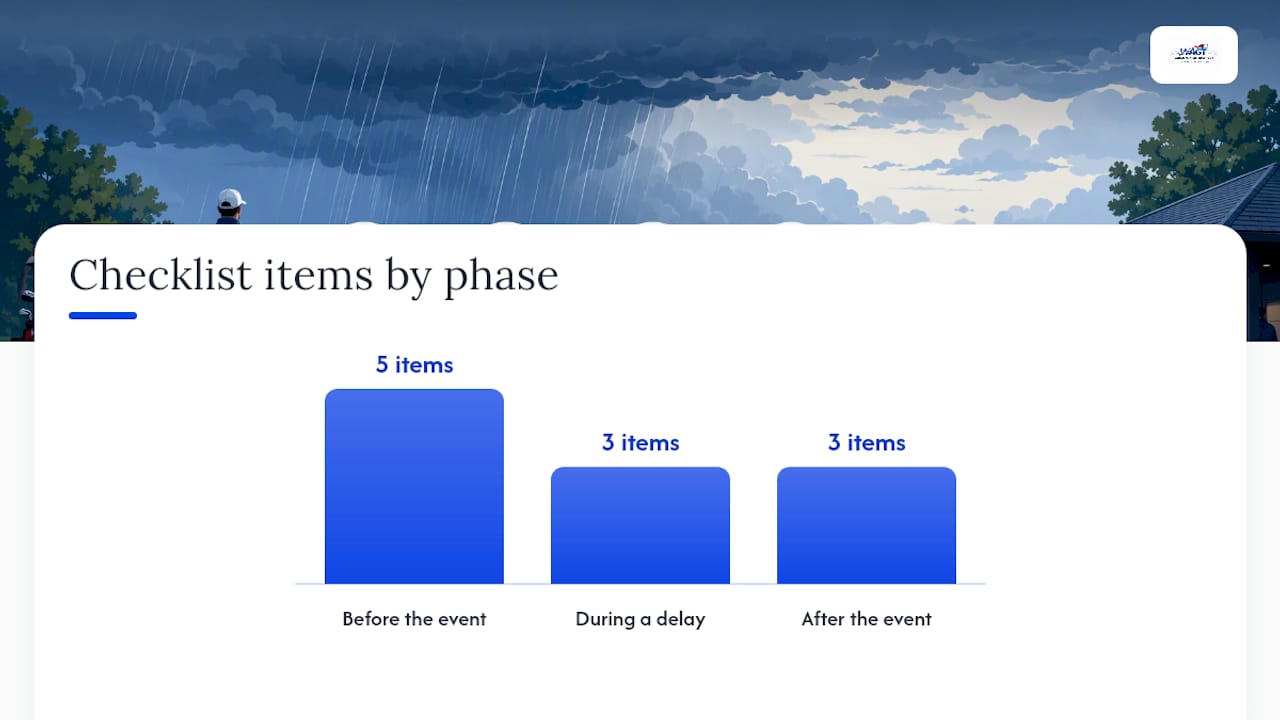
Your rain delay checklist: before, during, and after
Preparation separates players who handle disruptions smoothly from those who scramble. Use this checklist every time you enter a WAGR-counting event.
Before the event:
- Read the published weather and refund policy on the event page.
- Confirm refund and credit terms, including the registration close date.
- Manage your waitlist status actively; do not assume the organizer will contact you in time.
- Save the organizer's direct contact number and the tournament app or communication channel.
- Verify the event's WAGR-compliance notice is published.
During a delay:
- Follow suspension orders immediately; do not finish the hole first.
- Preserve your scorecard and mark your ball's position.
- Keep receipts for any refundable travel or lodging expenses if the event is cancelled.
After the event:
- Confirm the official result in writing with the organizer.
- Request the WAGR-compliance communication if it has not been sent.
- If points are missing or disputed, file through the official WAGR appeals process.
Pro Tip: Check the tee time scheduling posted after a delay. Committees often re-sequence groups, and your new tee time may differ significantly from your original slot.
A ready-to-use rain delay policy template for organizers
If you run a WAGR-counting event, your weather policy needs to be published before registration opens, not drafted the morning of a storm. Here is a copy-ready framework you can adapt.
Policy snippet:
Organizer operations checklist:
- Publish the weather policy and WAGR-compliance notice on the event page before registration opens.
- Establish notification channels (app, group text, email) and test them before event day.
- Confirm a lightning-safety and evacuation plan with course management.
- Set a decision timeline: aim to communicate suspend/shorten/cancel decisions within two to three hours of a stoppage.
- Document waitlist procedures and charge protocols in writing.
- After the event, send a post-event report to WAGR and communicate ranking outcomes to players.
Avoid the operational pitfalls that undermine player trust, such as vague refund language or missing WAGR notices, by reviewing common tournament hosting mistakes before your event launches.
Why clear rain delay policies matter more than most organizers realize
Most conversations about rain delays focus on logistics. The deeper issue is athlete development and fairness.
For a junior golfer building a WAGR profile toward a college scholarship, a poorly communicated cancellation is not just an inconvenience. It can mean a wasted travel budget, a missing ranking result at a critical recruiting window, and confusion about whether points were ever awarded. Parents who drove six hours and paid a $400 entry fee deserve a policy they can read before they leave home, not a verbal explanation at the parking lot.
The organizers who get this right publish their weather policy alongside their event details, communicate decisions within a defined window, and send a post-event WAGR confirmation to every player. That transparency is what separates a professionally run amateur event from one that players quietly avoid the following season.
Worldamateurgolftour's approach to weather and event integrity
Elite junior and collegiate golfers need more than a great course. They need an organization that handles the hard moments, like a weather delay in round two of a WAGR-counting 54-hole event, with the same professionalism as the first tee announcement.

Worldamateurgolftour runs committee-led events with published weather policies, clear refund and credit procedures, and WAGR-compliant post-event reporting built into every tournament. You know the refund tiers before you register, the suspension protocol before you tee off, and the ranking outcome before the leaderboard closes. For junior golfers on a recruiting timeline and parents managing travel budgets, that clarity is the competitive advantage. Review upcoming events and their published policies at Worldamateurgolftour and register for a WAGR-counting event that takes your development as seriously as you do.
Sources
These are the primary sources used throughout this article. Each one is worth bookmarking if you compete in or organize WAGR-counting amateur events in the United States.
Always check the specific event page for that event's published weather policy and WAGR-compliance notice. General guidance here is a starting point; the organizer's published terms govern your actual rights and obligations.