

A golf qualifying round is a single competitive round played under the Rules of Golf to earn entry into a tournament field or to produce an official score recognized by the World Handicap System (WHS). It serves two distinct purposes: determining who makes a tournament field when demand exceeds available spots, and generating Score Differentials that update your Handicap Index through USGA/GHIN. Whether you're chasing a club championship flight or working toward U.S. Open local qualifying, the same core principle applies: one round, real pressure, real stakes.
Table of Contents
- What is a golf qualifying round, and which formats count?
- Minimum holes, marker rules, and how to submit your score
- What are the different levels of qualifying in golf?
- How qualifying rounds affect your Handicap Index and tournament eligibility
- How to enter a qualifier and what to expect on the day
- How qualifying rounds connect to WAGR and amateur rankings
- Key Takeaways
- The one-round qualifier demands a different mindset
- Useful sources for qualifying rules and event listings
What is a golf qualifying round, and which formats count?
Not every round you play counts as a qualifying round for WHS or tournament purposes. The format has to allow an individual hole-by-hole score to be recorded and verified.
Formats that qualify:
- Individual stroke play (the most common, including Monthly Medal events)
- Stableford (points-based, but individual scores per hole are still tracked)
- Par/bogey competitions (match-style scoring against the course, individual scores recorded)
- Singles match play where hole-by-hole scores are recorded throughout
Formats that do not qualify:
- Scrambles and best-ball team events where individual hole scores can't be separated
- Foursomes and alternate-shot formats
- Four-ball events where individual scores are not independently recorded
- Most pair and team competitions where only a combined result is posted
WHS-eligible formats require that each player's individual score on every hole be available and attributable. A club scramble is a great social event, but it produces no qualifying score for handicap or tournament entry purposes. A Monthly Medal stroke play round, by contrast, counts for both.
One edge case worth knowing: four-ball events where each player records and signs their own card may be acceptable for handicap posting if your club's committee approves it. Club-specific rules can override the default, so always confirm with your handicap secretary before assuming a four-ball round will count.
Pro Tip: Before entering any competition, ask the tournament director or club secretary whether the format is WHS-approved. A two-minute conversation can save you from playing a full round that counts for nothing.
Minimum holes, marker rules, and how to submit your score
A round must be complete to count, but "complete" has a specific meaning under WHS. You need to finish at least 14 holes for an 18-hole round to be posted. If you complete 10–13 holes, you can still post a 9-hole score. Fewer than 10 holes played means no score can be submitted.
When holes are conceded or left unplayed in a match play qualifier, the WHS requires you to record the most likely score for each unfinished hole based on your performance up to that point. You can't simply skip a hole on the card. Tournament qualifying committees may handle unplayed holes differently from handicap posting rules, so check the event's local rules before teeing off.
The marker requirement is one of the most common failure points for amateur golfers. Under WHS and USGA guidance, your score must be:
- Recorded hole by hole by a marker (a fellow competitor or designated official)
- Checked and signed by you as the player
- Countersigned by your marker
- Submitted to GHIN or the club's designated system within the required window
Failure to have a proper marker countersign your card can invalidate the round entirely for handicap purposes, even if every score on the card is accurate. The USGA's GHIN system treats an unsigned or improperly witnessed card as a non-qualifying score.
The scale of what's at stake in formal qualifying puts these rules in sharp relief. For the U.S. Open, numerous local qualifying sites and a smaller number of final qualifying sites feed a final field of players. Every card at every one of those sites had to be properly signed and submitted.
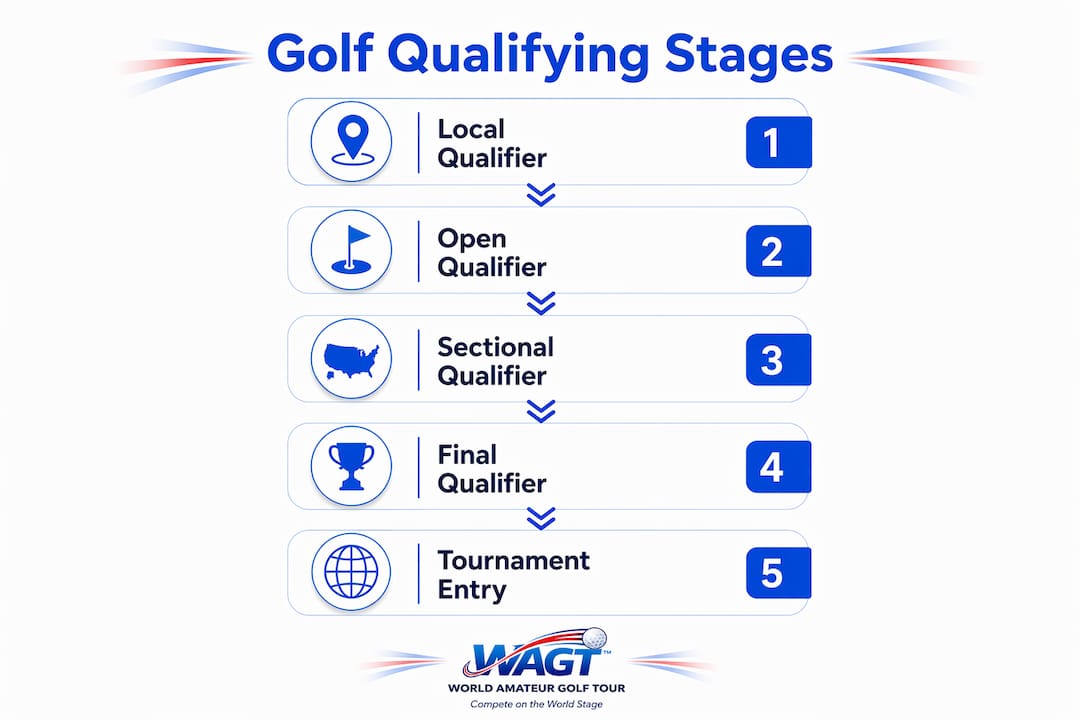
What are the different levels of qualifying in golf?
The qualifying ladder runs from your local club all the way to major championships. Here's how the levels stack up.
Club-level qualifiers are the entry point for most amateur golfers. These include club championship stroke play qualifiers, flight qualifiers, and seasonal competitions. Entry typically requires active club membership and, in many cases, a minimum number of posted rounds within the previous 12 months. Club handicap secretaries set these thresholds, and they vary widely.
Open and sectional qualifiers feed regional and national events. Unlike club qualifiers, open qualifiers are not restricted to members of a single club. Any eligible golfer can enter, subject to handicap limits and entry fees. Sectional qualifiers serve as a middle stage between open local rounds and national finals.
Monday qualifiers are the professional tour's open door. PGA Tour Monday qualifying events are 18-hole events held the Monday before tournament week, typically awarding four spots in the main field. Many aspiring pros must first clear a pre-qualifier to reach the Monday field, where they then compete against players who already hold tour status. Entry fees can be considerable for top-tier tours, often several hundred dollars.
Major championship paths are the most demanding. The U.S. Open structure is the clearest example:
| Stage | Format | Sites (2026) | Spots Advanced |
|---|---|---|---|
| Local qualifying | 18 holes | — | Varies by site |
| Final qualifying | 36 holes ("Golf's Longest Day") | 13 sites | — |
| Main field | 36 holes | 1 venue | — |
| PGA Tour Monday qualifier | 18 holes | Per-event | 4 spots typical |
Final qualifying is deliberately unforgiving. Thirty-six holes in a single day rewards sustained ball-striking and mental endurance, not just a hot front nine.
How qualifying rounds affect your Handicap Index and tournament eligibility
These are two separate systems, and confusing them is one of the most common mistakes amateur golfers make.
When you play a WHS-eligible qualifying round and post it correctly to GHIN, the system calculates a Score Differential for that round. Your Handicap Index is then derived from the best 8 of your most recent 20 Score Differentials. Every properly posted qualifying round feeds that calculation, whether or not it was part of a formal tournament.
Tournament eligibility is a different question entirely. Your current Handicap Index might be perfectly valid, but that doesn't automatically make you eligible for a specific club competition. Club bylaws frequently require a minimum number of club-designated qualifying rounds within a rolling 12-month window. A golfer who posts scores from casual rounds at other courses may have a current index but still fail to meet the club's competition entry threshold.
The notice of competition for any event is the authoritative document. It will specify the accepted formats, the handicap limit, the minimum qualifying rounds required, and any membership conditions. Your club secretary is the right person to ask when the notice is unclear.
Pro Tip: Don't assume your WHS Handicap Index alone qualifies you for a club championship. Check the club's bylaws and the specific notice of competition at least two weeks before the entry deadline. Posting scores and meeting tournament entry rules are separate processes.
How to enter a qualifier and what to expect on the day
Entering a qualifier correctly is half the battle. Here's the process from start to finish.
Before the event:
- Find open/sectional qualifiers through the USGA Championship Applications portal or the tournament's official notice of competition
- Confirm your handicap index meets the event's limit and that your club membership (if required) is current
- Pay the entry fee within the registration window; late entries are typically not accepted
- Review the notice of competition for format, tee times, and playoff procedures
On qualifier day:
- Arrive at least 45 minutes before your tee time for check-in and warm-up
- Confirm your marker assignment at registration; you are responsible for knowing who is marking your card
- Understand whether the event uses a shotgun start or sequential tee times
- Know the playoff procedure in advance; many qualifiers use sudden-death playoffs for tied qualifying spots
On-course tactics:
- Play conservatively on unfamiliar holes; a bogey is survivable, a double is not
- Avoid high-risk shots to par-5s in two; the reward rarely justifies the risk in a one-round qualifier
- Focus on keeping the ball in play off the tee rather than chasing distance
Pro Tip: For 18-hole local qualifiers, treat your warm-up as a full pre-round routine, not just a few swings on the range. For 36-hole final qualifying days, plan your nutrition and pacing from the first tee. Running out of energy on holes 28–36 is where most rounds unravel.

How qualifying rounds connect to WAGR and amateur rankings
Not every competitive round awards World Amateur Golf Ranking (WAGR) points, even when it's a legitimate qualifying event. WAGR recognition requires the event organizer to apply for and receive official WAGR designation, meeting specific criteria around field strength, format, and competitive structure.
A qualifying round can be both a WHS-eligible score and a WAGR-counting performance, but only when the event has been formally registered and approved by the WAGR organization. Playing in an unregistered event, however competitive, produces no WAGR points regardless of your score.
For junior and collegiate golfers building a ranking profile, this distinction is critical. Here's what to check before committing to an event:
- Confirm the event's WAGR status directly on the WAGR website or through the tournament director
- Review the field composition; WAGR points scale with field strength and the ranking of competitors in the field
- Check entry deadlines carefully; WAGR-counting events often have earlier cutoffs than standard amateur events
- Understand that Worldamateurgolftour events are specifically structured as WAGR-counting tournaments, giving junior and amateur golfers direct access to ranking points in professionally run competitive environments
For players targeting collegiate recruitment or a future professional pathway, the difference between a WAGR-counting event and a standard qualifier can be significant. Every ranking point earned in a properly structured event adds to your visibility with college coaches and tour scouts.
Key Takeaways
A qualifying round is only as valuable as the format, marker, and submission process behind it. Getting those details right is what separates a score that counts from one that doesn't.
| Point | Details |
|---|---|
| Definition and purpose | A qualifying round earns tournament entry or produces a WHS Score Differential; both purposes require proper format and submission. |
| Formats that count | Individual stroke play, Stableford, par/bogey, and singles match play with hole-by-hole scores qualify; scrambles and team formats do not. |
| Marker and submission | Your card must be signed by both you and your marker and submitted to GHIN; an unsigned card is invalid for handicap purposes. |
| Handicap vs. eligibility | A current Handicap Index and tournament eligibility are separate; club bylaws may require a minimum number of club-designated rounds. |
| WAGR status matters | Not all qualifying events award WAGR points; confirm event registration status before entering if ranking exposure is your goal. |
The one-round qualifier demands a different mindset
Single-round qualifiers are the purest and most unforgiving test in competitive golf. There is no second day to recover, no cut to survive and regroup. One bad stretch of holes can end your day before the back nine begins.
The expert consensus around 18-hole local qualifiers frames them as a "knife fight," and that description holds up. The players who advance are rarely the ones who went flag-hunting on every par-5. They're the ones who made pars when pars were available, limited their bogeys to one shot, and never let a single hole turn into a disaster.
Here's the practical truth most golfers learn the hard way: your A-game doesn't always show up on qualifier day. The course is unfamiliar, the pressure is real, and your margin for error is thin. The smarter play is to build a game plan around your B-game performing at its ceiling, not your A-game performing at its floor. Lay up when the risk isn't worth it. Take the extra club into a tough par-3. Give yourself a putt for par from 20 feet rather than a putt for birdie from 6 inches over a bunker.
For junior golfers especially, the mental discipline of a one-round qualifier is a skill that transfers directly to collegiate and professional competition. Learning to manage a scorecard rather than just swing a club is what separates players who qualify consistently from those who peak in practice.
Useful sources for qualifying rules and event listings
These are the primary references you should bookmark before entering any qualifying event.
- USGA Championship Applications: The official portal for entering USGA-sanctioned events, including U.S. Open local qualifying. Check here for entry windows, eligibility requirements, and site assignments.
- GHIN (ghin.com): The USGA's national handicap system for posting qualifying scores in the U.S. Use it to verify your current Handicap Index and confirm that your rounds have been properly recorded.
- PGA Tour Open Qualifying: Lists Monday qualifier dates, eligibility rules, and pre-qualifier information for PGA Tour events. Start here if you're exploring the Monday qualifier path.
- Worldamateurgolftour.com: The landing page for WAGR-counting amateur events in the U.S. Check here for event schedules, entry deadlines, and field composition if you're building a WAGR ranking profile.
- WHS Rules of Handicapping (usga.org): The authoritative source for format eligibility, Score Differential calculations, and posting requirements under the World Handicap System.
- Notice of competition (event-specific): Always the binding document for site-specific rules, tee times, playoff procedures, and eligibility. No secondary source overrides it.
This article is general information about golf qualifying rules and processes. For your specific situation, confirm current requirements with the USGA, your club's handicap secretary, or the tournament director of the event you plan to enter.