

The most useful tournament playoff formats are single-elimination, best-of series, round-robin (or group-plus-knockout hybrids), double-elimination, stepladder/Page–McIntyre variants, aggregate/two-leg ties, and golf-specific sudden-death or multi-hole aggregate playoffs. Each format solves a different problem. According to the Playoff format overview on Wikipedia, these structures span a wide spectrum from maximum drama to maximum fairness, and the right choice depends almost entirely on your event's time window, field size, and what you want the competition to reward.
Here is the quick-reference rule for each:
- Single-elimination: One loss ends your run. Use it when you have one day, a large field, and want maximum drama.
- Best-of series (3/5/7): Multiple games reduce variance. Use it when you need the strongest competitor to prevail and have the schedule to support it.
- Round-robin / group-plus-knockout hybrid: Every team plays multiple matches before elimination. Use it when fairness over a full sample matters and you have at least two to three days.
- Double-elimination: Two losses required to exit. Use it when you want a safety net for top competitors without committing to a full round-robin.
- Stepladder / Page–McIntyre: Higher seeds get a second chance built into the bracket. Use it when you want to reward regular-season performance while keeping finals compelling.
- Aggregate / two-leg ties: Total score across two legs determines the winner. Use it when home-and-away balance is a priority and you have two venues or dates.
- Golf sudden-death playoff: Hole-by-hole until one player wins outright. Use it for stroke-play events where a quick resolution is needed after 18 or 36 holes.
- Multi-hole aggregate golf playoff: A set number of holes (2, 3, or 4) played in full. Use it when you want to reduce luck while still keeping the playoff compact.
Short events (single day, large field): Single-elimination, play-in rounds, sudden-death golf playoffs. Mid-length championships (2–4 days): Round-robin groups into knockout, double-elimination, Page–McIntyre. Extended series (week-plus): Best-of-5 or best-of-7, aggregate two-leg ties, full McIntyre Final Eight.
Key Takeaways
Choosing the right playoff format comes down to three inputs: field size, available time, and whether you prioritize fairness or drama.
| Point | Details |
|---|---|
| Match format to event constraints | Single-elimination fits one-day events; best-of series and round-robin fit multi-day championships where fairness matters. |
| Write tie-break rules before registration | USGA guidance requires playoff methods in the Terms of Competition; ambiguity is the leading cause of disputes. |
| Reward seeding with the right structure | Page–McIntyre and double-elimination give higher seeds a second chance without requiring a full round-robin. |
| Golf playoffs favor aggregate over sudden-death | A 2-hole or 3-hole aggregate playoff reduces luck and satisfies WAGR documentation requirements better than sudden-death. |
| Worldamateurgolftour supports organizers | WAGR-counting events through Worldamateurgolftour include operational frameworks, live scoring, and verified Terms of Competition. |
Table of Contents
- What are the main tournament playoff formats and how do they work?
- How do the formats compare across the dimensions organizers care about?
- How do major U.S. leagues and marquee events use these structures?
- What are the golf-specific tie-break rules you need to know?
- How do you choose the right playoff format for your event?
- What does solid playoff implementation actually look like?
- How does Worldamateurgolftour approach amateur and junior golf playoffs?
- What mistakes do organizers make most often, and how do you fix them?
- Why clarity beats complexity every time
- Worldamateurgolftour makes playoff planning easier for serious events
- Sources
What are the main tournament playoff formats and how do they work?
Understanding the mechanics of each format is the foundation for every decision that follows. The Playoffs overview on Wikipedia describes a playoff as the elimination stage that follows a regular season, ranging from a single decisive game to a multi-round series or full tournament bracket.
Single-elimination
Every match is decisive. Lose once and you are out. The bracket pairs competitors from the first round through to the final, with the winner advancing each time. The NCAA Tournament (March Madness) is the most recognizable example in the United States: 68 teams enter, and 67 games later, one champion stands. The format is fast, inexpensive to run, and generates genuine tension in every match. The trade-off is that a single bad day can eliminate the strongest competitor in the field.
Double-elimination
A competitor must lose twice before being eliminated. The bracket splits into a winners' side and a losers' side; a loss on the winners' side drops you to the losers' bracket rather than ending your run. College baseball's NCAA tournament uses this structure in its regional rounds. Double-elimination roughly doubles the number of matches compared to single-elimination, which raises scheduling and venue costs, but it gives top competitors a meaningful safety net.
Round-robin
Every competitor plays every other competitor at least once. Points accumulate across matches, and the standings determine who advances to a knockout stage. Group-stage formats in the FIFA World Cup and many regional soccer leagues use this structure before the knockout rounds begin. Round-robin stages guarantee a minimum number of matches per entrant and filter the most consistent performers, with tiebreakers typically resolved by head-to-head result, then goal or stroke difference, then total goals or strokes scored.
Best-of series
Two competitors play a set number of games, and the first to win a majority advances. Best-of-3 requires two wins; best-of-5 requires three; best-of-7 requires four. The NBA, NHL, and MLB all use best-of-7 series in their championship rounds. Longer series reduce the influence of a single bad performance and raise the probability that the stronger team advances, which is why leagues with significant travel budgets and broadcast contracts favor them.
Aggregate / two-leg ties
Each side hosts one match, and the combined score across both legs determines the winner. UEFA Champions League knockout rounds are the most prominent global example. In the United States, this format appears less frequently, though MLS used home-and-away structures in earlier playoff iterations. Away-goals rules (where goals scored away from home counted double in a tie) were once common but have been phased out by most governing bodies.
Stepladder / Page–McIntyre system
The Page–McIntyre system is a four-team playoff structure widely used in cricket, curling, softball, and some T20 leagues. The top two seeds play each other, with the winner going directly to the final and the loser getting a second chance through a semifinal against the winner of the match between seeds 3 and 4. This "double chance" for the top seeds rewards strong regular-season performance without requiring a full double-elimination bracket.
The McIntyre Final Eight system extends this logic to eight teams, with higher seeds receiving a double chance in the first week of matches. The critical scheduling rule: matches must be sequenced so that no team plays a match whose outcome has already been made irrelevant by an earlier result. Violating this principle undermines competitive integrity.
Play-in tournaments
A play-in round determines the final spots in the main bracket. The NBA introduced its play-in tournament in 2021, allowing the 7th through 10th seeds in each conference to compete for the 7th and 8th playoff berths. Play-ins expand participation and create additional high-stakes games without extending the main bracket.
Pro Tip: For amateur events with uneven field sizes, a play-in round is an elegant way to reach a clean bracket number (8, 16, 32) without giving byes to teams that did not earn them through seeding.
How do the formats compare across the dimensions organizers care about?
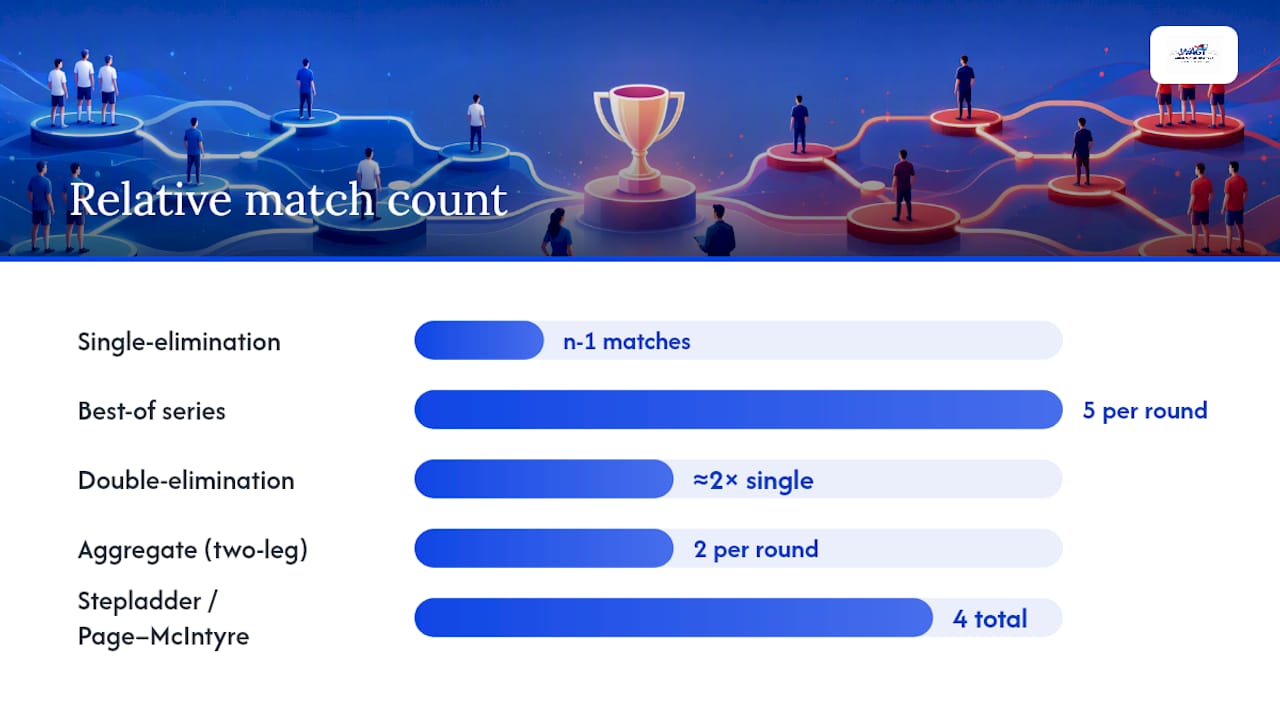
| Format | Best for | Fairness | Drama | Match count | Seeding reward | Complexity | Ideal field size |
|---|---|---|---|---|---|---|---|
| Single-elimination | Short events, large fields | Low | Very high | n-1 | Low | Low | 8–32 |
| Best-of-3/5/7 | Championship rounds | High | High | 3–7 per round | Moderate | Moderate | 2–16 |
| Round-robin + knockout | Multi-day, fairness-first | High | Moderate | Many | Moderate | High | 4–20 |
| Double-elimination | Mid-length, safety net | Moderate-high | Moderate | ~2x single-elim | Moderate | Moderate-high | 4–16 |
| Aggregate / two-leg | Home-and-away balance | Moderate | Moderate | 2 per round | Low | Moderate | 4–16 |
| Stepladder / Page–McIntyre | 4–8 team finals | Moderate-high | High | 3–5 total | High | Moderate | 4–8 |
| Play-in | Expanding bracket access | Moderate | High | 2–3 extra | Low | Low | 4–6 extra teams |
How do major U.S. leagues and marquee events use these structures?
The variety of postseason formats across U.S. leagues reflects deliberate trade-offs between television revenue, travel logistics, competitive fairness, and fan engagement. No single format dominates because no single set of priorities applies to every sport.
MLB runs one of the most layered postseasons in American sports. The Wild Card Series is a best-of-3 played entirely at the higher seed's ballpark, a change from the earlier single-elimination wild card game. The Division Series is best-of-5, the League Championship Series best-of-7, and the World Series best-of-7. The home-field format within series shifted from the old 2-3-2 arrangement to 2-2-1-1-1, giving the higher seed more home games earlier in the series. Each structural change was driven by a mix of travel cost reduction and competitive fairness arguments.
NBA added its play-in tournament as a permanent fixture starting in 2021. Seeds 7 through 10 in each conference compete for the final two playoff spots, with the 7-seed needing one win and the 10-seed needing two consecutive wins to advance. The main bracket then runs best-of-7 in every round, a format the league has used since 2003 when it eliminated the best-of-5 first round.
NHL brackets are conference-based, with four rounds of best-of-7 series. The higher seed hosts Games 1, 2, 5, and 7 (if needed), following a 2-2-1-1-1 format. The conference structure means teams from the same division can meet multiple times in a single postseason, which the league views as a feature rather than a flaw.
MLS adopted a hybrid structure after 2023. The MLS Cup Playoffs now combine single-match rounds in later stages with a best-of-3 first round, balancing the league's desire for more playoff games against the compressed schedule of a league that shares the calendar with international competitions. Conference brackets feed into a neutral-site final.
NCAA Tournament is the purest single-elimination bracket in American sports at scale: 68 teams, six rounds, one champion. The format's ruthlessness is also its appeal. Every game is a must-win, which produces the upsets and buzzer-beaters that make March Madness a cultural event.
PGA Championship and major golf playoffs have used different tie-break methods over the decades. The PGA Championship used sudden-death for many years before shifting to a 3-hole aggregate playoff. The Masters uses sudden-death beginning at the 18th hole. The U.S. Open moved from an 18-hole playoff round to a 2-hole aggregate playoff. These changes reflect the sport's ongoing effort to balance competitive integrity with broadcast and scheduling realities.

Pro Tip: When studying league format changes, look at what changed and why. The NBA's shift to all best-of-7 rounds in 2003 was driven by fairness arguments after several upsets in best-of-5 first rounds. Your event's format should be equally deliberate.
What are the golf-specific tie-break rules you need to know?
Golf tie-breaking rules differ meaningfully between match play and stroke play, and the distinction matters for every organizer writing a Terms of Competition document.
Match play tie procedures
Under USGA Rule 3, a match play competition must be extended hole-by-hole until one player wins a hole outright, unless the Terms of Competition explicitly state that a tie is an acceptable result. This means that unless you write a specific exception into your event rules, every match play contest must produce a winner on the day. The R&A's Rule 3 aligns with this position, treating match play and stroke play as distinct forms with their own resolution logic.
For most amateur events, the practical implication is straightforward: if a match reaches the 18th hole all-square, players continue to the 19th, 20th, and beyond until someone wins a hole. Organizers should specify the starting hole for sudden-death extension (usually the 1st or 10th) and confirm that daylight and course availability allow for extra holes.
Stroke play playoff variants
Stroke play ties in professional majors have been resolved through several methods:
- Sudden-death: Players compete hole-by-hole until one player scores lower. The Masters uses this format, beginning at the 18th hole.
- 2-hole aggregate: Players complete two designated holes, and the lower combined score wins. The U.S. Open adopted this format to replace its previous 18-hole playoff round.
- 3-hole aggregate: The PGA Championship currently uses a 3-hole aggregate playoff.
- 4-hole aggregate: Used by some European Tour events.
- 18-hole playoff round: Historically used by the U.S. Open and the Open Championship; now largely phased out at the professional level due to scheduling and broadcast constraints.
Pro Tip: For amateur and junior events, a 2-hole or 3-hole aggregate playoff is usually the right call. It reduces the luck factor of sudden-death while keeping the playoff compact enough to finish before dark.
The evolution of the PGA Championship's playoff rules illustrates how governing bodies adapt. The championship used sudden-death for decades, then moved to a 3-hole aggregate to give players a slightly larger sample while still resolving ties on the same day.
Sample Terms of Competition wording
Organizers can adapt the following language for their events:
"In the event of a tie at the conclusion of regulation play, the competition will be decided by a [2-hole / 3-hole / sudden-death] playoff beginning at hole [X]. Players will be notified of the playoff start time no later than [Y minutes] after the conclusion of the final round. If a playoff cannot be completed due to darkness or course unavailability, the result will be determined by [scorecard countback / coin flip / rescheduled date]."
The USGA committee guidance on match play reinforces that committees must state their playoff method in the Terms of Competition to avoid ambiguity. Leaving this language out is one of the most common and costly mistakes an organizer can make.
For a deeper look at golf qualifying round rules and how they interact with playoff structures, that resource covers the mechanics in detail.
How do you choose the right playoff format for your event?
The right format follows directly from your event's constraints. Work through these inputs before committing to a structure.
- Count your field. Under 8 competitors: single-elimination or round-robin. 8–16: single-elimination, double-elimination, or Page–McIntyre. 16–32: single-elimination with seeding or group-plus-knockout hybrid. Over 32: group stages into single-elimination knockout.
- Set your time window. One day: single-elimination or sudden-death playoff. Two to three days: double-elimination, round-robin groups, or Page–McIntyre. Four or more days: best-of series or full round-robin.
- Define your fairness threshold. If the best competitor must win, use best-of series or round-robin. If drama and schedule efficiency matter more, use single-elimination.
- Decide whether a double chance is required. If you want to reward regular-season performance, use Page–McIntyre or double-elimination. If every team starts equal, use single-elimination.
- Check venue availability. Multi-day formats require confirmed access across all days. Weather contingency plans must be written before the event, not during it.
- Set your seeding method. Seeding by regular-season points is the most common approach. Specify the tiebreaker order: head-to-head record, then point differential, then total points scored, then a playoff or coin flip if still tied.
Red flags that push you away from long formats:
- Travel distances that make multi-day attendance difficult for amateur competitors
- Venue availability limited to a single day
- Weather risk in outdoor events without covered facilities
- Budget constraints that cannot absorb additional officiating or venue costs
Red flags that push you away from single-elimination:
- A field where seeding is unreliable or unverified
- A governing body requirement that the best competitor must demonstrably prevail
- Sponsors or broadcasters who need a minimum number of matches guaranteed
Pro Tip: For amateur tournament types that include college recruiting exposure, prioritize formats that guarantee each player at least two rounds of competitive play. A single-elimination format where a top junior loses in round one and goes home is a poor experience for the player and a missed opportunity for coaches watching.
Hybrid formats combining group stages and knockout rounds let organizers expand participation while keeping a manageable schedule and a clear pathway to the final, making them an increasingly popular choice for regional and amateur events.
| Event profile | Recommended format | Why |
|---|---|---|
| 1-day, 8–16 teams | Single-elimination | Fast, low cost, high drama |
| 2-day, 8–16 teams | Double-elimination or Page–McIntyre | Safety net, rewards seeding |
| 3-day, 12–20 teams | Round-robin groups + knockout | Fairness, guaranteed matches |
| Multi-day, 2–8 teams | Best-of-3 or best-of-5 series | Variance reduction, prestige |
| Golf, stroke play tie | 2-hole or 3-hole aggregate | Balance of fairness and speed |
| Golf, match play tie | Sudden-death extension | USGA/R&A standard |
What does solid playoff implementation actually look like?
Choosing the right format is step one. Running it cleanly is where most organizers struggle.
Seeding and bracket setup
- Publish your seeding criteria before registration closes. Players and teams should know exactly how seeds are assigned: regular-season points, world ranking, handicap index, or a combination.
- Set a tiebreaker order for seeding disputes: head-to-head record first, then point differential, then total points scored, then a designated playoff match or coin flip.
- Fix the bracket before the event starts. Re-seeding after each round (as the NBA does) is an option for longer formats but adds administrative complexity and requires clear pre-announcement.
- Assign byes to the highest seeds in fields that are not a power of two. A 12-team single-elimination bracket gives byes to the top four seeds, who enter in the second round.
Scheduling and venue logistics
For multi-day events, build a scheduling template that accounts for match duration, rest time between matches, and travel between venues. Tee time scheduling in golf requires particular attention to daylight windows and course turnaround time.
- Confirm venue availability for every possible match, including potential extra rounds in double-elimination or best-of series.
- Assign home/away or tee order before the event using a published rule (higher seed chooses, or alternating based on bracket position).
- Build a weather contingency into the schedule: a minimum 90-minute delay window before a match is postponed, with a designated backup date or alternate resolution method.
Sample Terms of Competition template
Organizers can adapt this language:
"The playoff bracket will be seeded by [criterion]. Ties in seeding will be resolved by [head-to-head / point differential / coin flip]. All matches will be played at [venue] on [dates]. In the event of a weather delay exceeding [X hours], the match will be rescheduled to [backup date] or resolved by [countback / coin flip]. Match officials are assigned by [committee/body] and their decisions on rules questions are final pending formal protest."
For golf event local rules and how they interact with playoff procedures, that resource provides practical wording you can adapt directly.
Pro Tip: Assign a dedicated rules official to every playoff match, not just the final. Disputes in early rounds that go unresolved create precedent problems later. Clear official roles and responsibilities should be documented and distributed before the event starts.
When implementing Page–McIntyre or McIntyre Final Eight systems, sequence your first-week matches carefully. The McIntyre system's integrity depends on every match mattering: if a team has already secured advancement before their final group match, the incentive structure collapses and competitive integrity suffers.
How does Worldamateurgolftour approach amateur and junior golf playoffs?
Worldamateurgolftour operates WAGR-counting events where the stakes of playoff and tie-break decisions are real: ranking points, college recruiting visibility, and player development all depend on fair, well-run competition. The practices below reflect what works in that environment.
Recommended formats by event type
- Club championship (single day, 8–32 players): Stroke play with a 2-hole aggregate playoff for ties. Sudden-death is acceptable if daylight is a constraint, but specify it in advance.
- Junior series (multi-day, 16–64 players): Stroke play qualifying rounds followed by match play brackets for the top 8 or 16 qualifiers. This mirrors the format used in USGA junior championships and gives players experience in both forms of play.
- Multi-day open (54-hole or 72-hole stroke play): Stroke play throughout, with a 3-hole aggregate playoff for ties on the final day. If the event counts for WAGR, the playoff method must be specified in the Terms of Competition submitted to the ranking body.
Organizer checklist for WAGR-counting events
- Confirm the playoff method is documented in the Terms of Competition before the event is sanctioned.
- Verify that all competitors are registered and handicap-verified before the first round.
- Assign a qualified referee to each playoff match or playoff hole.
- Establish a score verification process: all scorecards signed and submitted before results are posted.
- Communicate the playoff format to all players at the pre-tournament briefing, not just in the written rules.
- Set a firm daylight cutoff and a documented backup resolution method (countback or rescheduled date) in case a playoff cannot be completed.
Pro Tip: For WAGR-counting events, a 2-hole or 3-hole aggregate playoff is preferable to sudden-death. It gives ranking bodies a cleaner result and reduces the chance that a single hole's luck determines a ranking-point outcome.
For events that include college recruiting exposure, Worldamateurgolftour's player profiles and recruiting tools give coaches visibility into every competitor's performance across the full event, not just the playoff result. That context matters when a junior loses a 2-hole aggregate playoff by a single stroke.
What mistakes do organizers make most often, and how do you fix them?
Most playoff disputes trace back to decisions made (or not made) before the event started. The following patterns appear repeatedly across amateur and junior golf events.
Common mistakes:
- Publishing Terms of Competition without specifying the playoff method, leaving the committee to improvise under pressure
- Seeding competitors without a published tiebreaker order, then facing a dispute when two teams finish level on points
- Building a bracket for a fixed field size without a contingency for late withdrawals
- Selecting playoff holes in golf without confirming they are available and properly set up on the day
- Failing to communicate format changes (weather delays, schedule compression) to all competitors simultaneously
- Scheduling matches so that a later result in the bracket is irrelevant to a team's advancement, undermining competitive integrity
Dispute resolution checklist:
- Stop the match or round immediately if a rules question arises that could affect the result.
- Refer the question to the designated rules official. Do not allow players to resolve rules disputes among themselves.
- Issue a provisional result if the dispute cannot be resolved before play must continue.
- Document the dispute in writing: time, hole or match, players involved, the specific rule in question, and the official's ruling.
- Communicate the final ruling to all affected competitors before posting official results.
- Escalate to the committee only if the rules official's ruling is formally protested in writing within the time window specified in the Terms of Competition.
When to use a replay vs. a scheduled playoff match: A replay is appropriate when an external factor (course condition, weather, equipment failure) made the original result unreliable. A scheduled playoff match is appropriate when the original competition was completed fairly but produced a tie. Never use a coin flip as a first resort; reserve it for situations where all other tiebreakers have been exhausted and a replay is not feasible.
Pro Tip: Hold a five-minute rules briefing at registration for every playoff event. Cover the playoff format, the tiebreaker order, the weather contingency, and who to contact with a rules question. Most disputes start with a player who did not read the Terms of Competition.
Why clarity beats complexity every time
There is a temptation in tournament design to reach for the most sophisticated format available. A McIntyre Final Eight with re-seeding, aggregate scoring, and a play-in round sounds impressive. In practice, it often produces confusion, disputes, and a final round that half the field does not understand.
The formats that produce the best player experiences are almost always the simplest ones that still meet the event's core objectives. A well-run single-elimination bracket with clear seeding and a published tiebreaker order will generate more goodwill than a complex hybrid that no one can explain without a diagram. The same principle applies to golf tie-break rules: a 2-hole aggregate playoff that every player understood at registration is better than a sudden-death format that surprises the field when it happens.
Complexity is not a proxy for quality. The PGA Championship did not become more prestigious when it moved from sudden-death to a 3-hole aggregate. It became more defensible. That is the right goal for any organizer: a format you can defend to every competitor, sponsor, and governing body because you chose it deliberately and communicated it clearly.
Prioritize transparency. Publish your format before registration opens. Write your Terms of Competition in plain language. Brief your players before the first round. Those three steps will prevent more disputes than any format change ever could.
Worldamateurgolftour makes playoff planning easier for serious events
Running a competitive amateur or junior golf event that counts for WAGR requires more than a good format on paper. It requires operational infrastructure: sanctioned Terms of Competition, verified scoring, referee assignment, and a player experience that reflects the quality of the competition.

Worldamateurgolftour provides exactly that. Events on the tour are professionally run at championship-caliber courses, with live scoring, player ranking tracking, and recruiting tools that give college coaches real visibility into every competitor. For organizers, that means reduced administrative burden and a framework that meets WAGR requirements from day one. For players, it means competing in events where the playoff rules are clear, the scoring is verified, and the ranking points are real.
If you are organizing an amateur or junior golf event and want the structure, support, and WAGR recognition that serious competition demands, visit Worldamateurgolftour to learn more about hosting or joining a sanctioned event.
Sources
The following sources were used in preparing this guide and are worth consulting directly for official rules, format documentation, and deeper study.